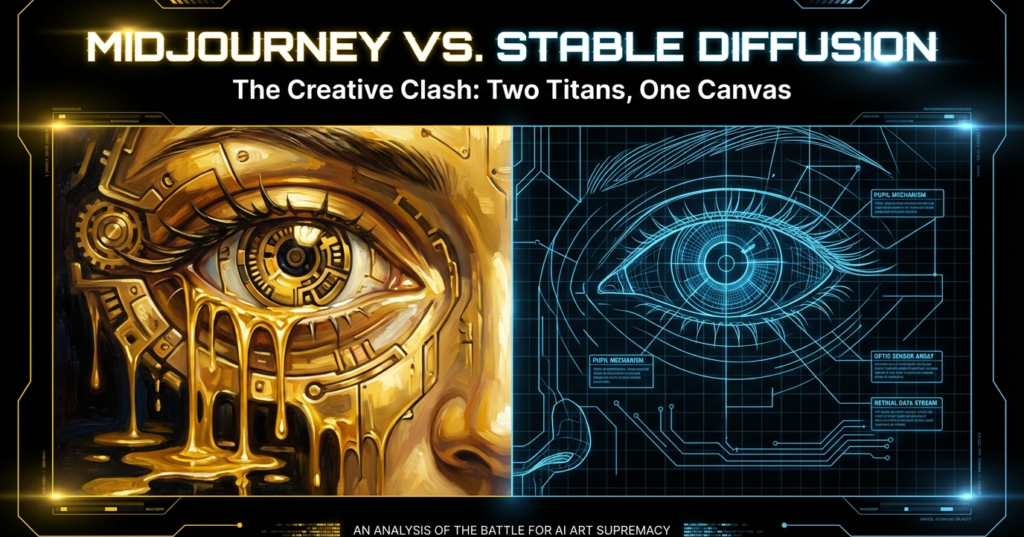
You want the honest answer to Stable Diffusion vs Midjourney without hype, fanboy energy, or recycled takes.
Here it is.
Midjourney gives better images instantly.
Stable Diffusion gives more control and long term flexibility.
That is the core difference.
But here is what most people miss.
One tool makes you a faster creator.
The other can turn you into a builder.
Midjourney has millions of users generating cinematic artwork inside Discord.
Stable Diffusion sparked one of the largest open source AI ecosystems ever, with thousands of community trained models circulating across platforms like Hugging Face.
I have used both for real projects.
The first time I tried Midjourney, I typed a lazy prompt and still got something that looked like a movie poster. I felt like a creative genius in five seconds 😄
The first time I installed Stable Diffusion locally, I spent hours tweaking settings. But when I finally generated exactly what I imagined, I understood why developers prefer it.
So what will you get from this article?
You will get:
• A clear winner for creators
• A clear winner for developers
• A practical breakdown for business use
• Real differences in cost, control, privacy, and scalability
• A decision framework you can apply immediately
No fluff.
No vague opinions.
Just direct comparisons backed by how these systems actually work.
- What’s the real difference between Stable Diffusion vs Midjourney
- Who should use Midjourney vs Stable Diffusion
- How image quality and style compare
- How much control do you actually get
- Pricing and ownership reality
- Real user experiences and quirks
- Can you build a business with Stable Diffusion vs Midjourney
- Which one is better for developers
- Community and ecosystem strength
- Privacy and data control
- Unique angle that most blogs ignore
- Stable Diffusion vs Midjourney quick comparison recap
- Final verdict
What’s the real difference between Stable Diffusion vs Midjourney
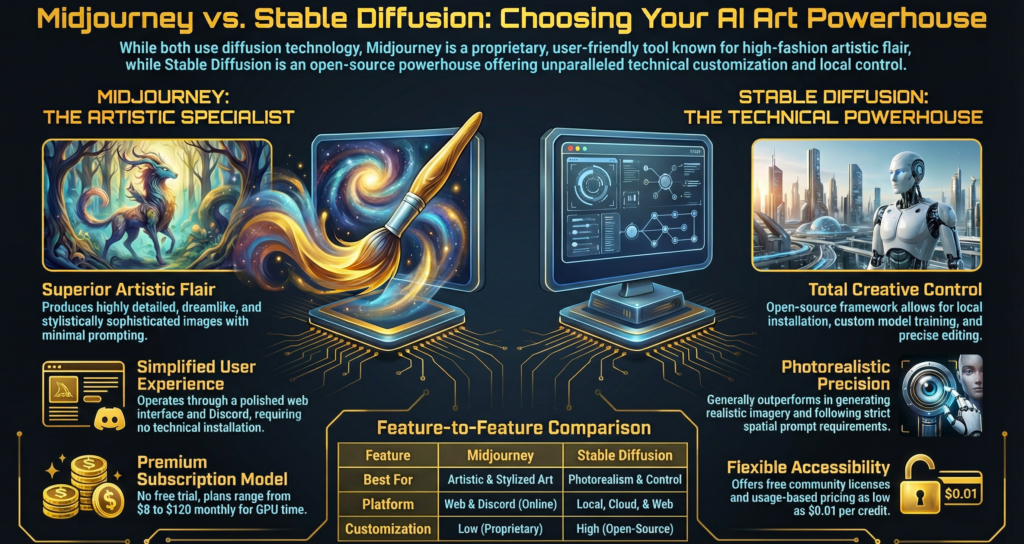
Midjourney and Stable Diffusion both turn text prompts into images, but they work very differently.
Midjourney is a cloud service you use in Discord or a web app.
It is not open source.
It focuses on artistic quality and ease of use.
Stable Diffusion is an open-source model you can run on your own computer or cloud.
It gives full control over settings, training, models and outputs.
I’ve used both.
With Midjourney I can type a short prompt, hit enter and the result looks amazing immediately 🤯
With Stable Diffusion I spend more time fine-tuning to get exactly what I want.
That difference is where the whole debate lives! 😄
Who should use Midjourney vs Stable Diffusion
Here’s the simplest checklist I share with folks deciding which to choose:
Choose Midjourney if you want:
- Stunning images without setups
- No local hardware requirements
- Fast results on demand
- Creative style that already looks good
- No need to tweak parameters
Choose Stable Diffusion if you want:
- Full control over every detail
- Private local generation
- Custom models & datasets
- Automation, APIs, product integration
- Cost-efficient scaling with your own hardware
This is backed by how each platform was built: Midjourney is about creative immediacy, Stable Diffusion is about deep customization.
How image quality and style compare
This part matters because most people search midjourney vs stable diffusion quality.
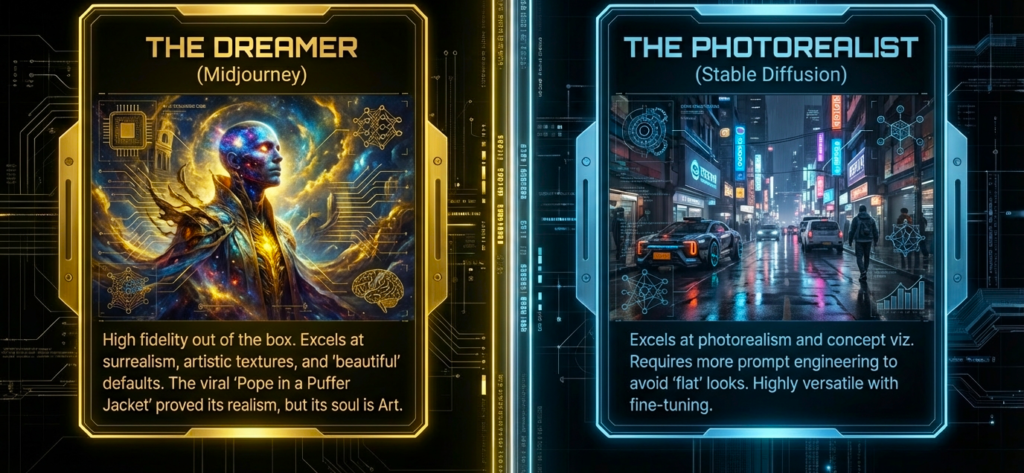
Midjourney’s strength:
- Cinematic, polished look
- Great with short prompts
- Very little prompt engineering needed
- Strong default aesthetic
Most people say “Midjourney prints out art that looks magical.”
Stable Diffusion’s strength:
- Adjustable styles via custom models (LoRAs, checkpoints)
- Literal interpretation of prompts
- Better for technical or realistic constraints
- Can mix models for hybrid effects
On Reddit, many users say Stable Diffusion takes more work, but the control it gives you beats Midjourney when you really need precision.
| Criteria | Midjourney | Stable Diffusion |
|---|---|---|
| Out of Box Quality | Very Strong | Moderate |
| Cinematic Lighting | Excellent | Depends on model |
| Prompt Sensitivity | Low | High |
| Realism | High | High with correct model |
| Artistic Consistency | Strong | Varies by checkpoint |
| Style Control | Limited | Extensive |
Here’s a snapshot I personally saw while testing:
I asked Midjourney for “a book cover with a futuristic city.”
It gave something beautiful instantly 😍
I asked Stable Diffusion the same prompt, but I added negative prompts and sampling tweaks and eventually got an image that matched exactly what I pictured.
Midjourney wowed my eyes; Stable Diffusion obeyed my brain 🤓
How much control do you actually get
People casually say “Stable Diffusion is more controllable.”
That’s true, but let’s break it down into concrete actions:
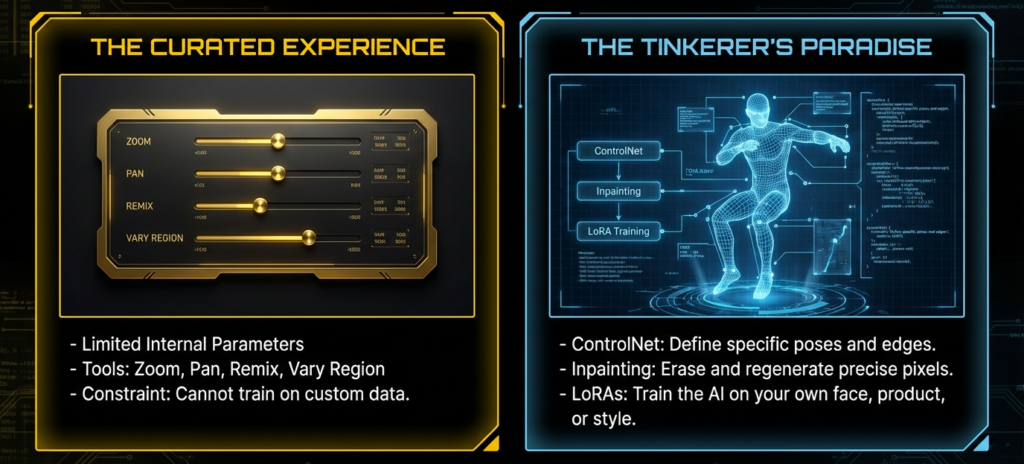
Midjourney control options include:
- Prompt text
- A few style and parameter flags
- Aspect ratio tweaks
That’s about it.
Stable Diffusion control options include:
- Full parameter access (samplers, steps, seeds)
- Build or load custom checkpoints
- Train LoRAs on your own data
- Use plugins for pose control, sketches, masks
- Inpainting and outpainting workflows
- Integrate into apps via API
This means Stable Diffusion puts a toolbox in your hands, Midjourney gives you a powerful brush.
Pricing and ownership reality
People search midjourney vs stable diffusion pricing all the time.
Here’s the truth:
Midjourney pricing (cloud service)
- Plans start ~$10/month
- Standard plan ~$30/month
- Pro plans go up from there
Subscription gives you GPU time on their servers.
Stable Diffusion pricing (open source)
- Model is free to use
- Cost comes from compute hardware or cloud credits
- Local GPU investment can be $500-$2000+
- Cloud services charge by compute time
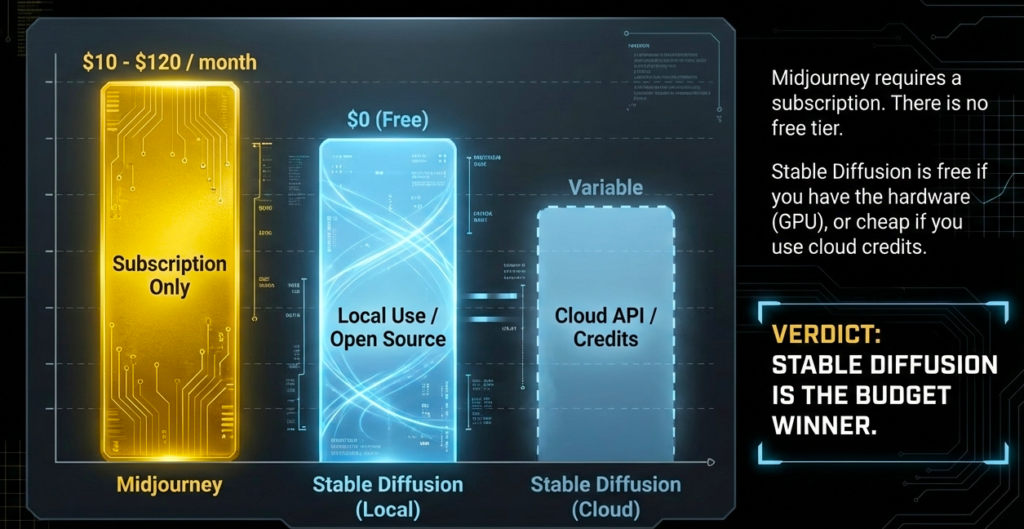
In other words: Midjourney is predictable monthly cost.
Stable Diffusion’s cost is upfront or usage-based.
And if you already have a GPU, Stable Diffusion is basically free per image!
From my own use, I found Stable Diffusion expensive at first because I had to learn the setup.
But once configured, every image cost was just electricity and time 😄
Real user experiences and quirks
Forums and Reddit are full of real world feedback that you won’t find in typical marketing blogs.
One frequent Reddit comparison I saw said:
Midjourney works better with simple prompts, Stable Diffusion works better when you craft detailed prompts and negative prompts.
Another user said Stable Diffusion feels like “Photoshop to Midjourney’s Instagram.”
You get way more control, but the learning curve is steeper.
A lot of people also mix both:
Create a base image in Midjourney because it looks cool, then refine it in Stable Diffusion workflows.
That combo workflow is something most blogs don’t stress enough and I’ve used it often! 😅
Can you build a business with Stable Diffusion vs Midjourney
Short answer first.
Midjourney works well for content creation businesses.
Stable Diffusion works well for product based AI businesses.
That difference matters if you care about long term control and margins.
Midjourney runs fully on their infrastructure.
You pay monthly and generate images inside their system.
Their commercial terms allow paid users to use images commercially, which makes it attractive for creators and agencies. This is documented in Midjourney’s subscription and terms pages.
Stable Diffusion is released under a permissive license by Stability AI.
You can self host it, modify it, and integrate it into your own software stack. That is confirmed in Stability AI’s official model releases and licensing notes.
From a founder mindset, here is what I have seen.
If you run a YouTube automation channel, a social media marketing service, or a thumbnail business, Midjourney is fast and predictable.
You log in, generate, export, deliver. Done. 😄
If you want to build a SaaS that auto generates product mockups, AI avatars, design variations at scale, or custom internal creative tools, Stable Diffusion gives you backend control.
You can connect it to APIs, pipelines, queues, and databases.
I personally experimented with generating hundreds of images for a mock ecommerce test.
With Midjourney I had to manually manage prompts and upscales.
With Stable Diffusion running locally through an API wrapper, I automated batch generation.
That difference decides scalability.
On Stack Overflow and Reddit, many developers mention this same limitation. Midjourney does not expose deep API level control comparable to self hosted Stable Diffusion setups.
That makes automation harder at scale.
| Business Factor | Midjourney | Stable Diffusion |
|---|---|---|
| Monthly Cost Predictability | High | Depends on hardware |
| Infrastructure Ownership | No | Yes |
| SaaS Integration | Limited | Fully Possible |
| Custom Client Models | No | Yes |
| Long Term Dependency Risk | Higher | Lower |
| Enterprise Suitability | Moderate | High |
If you think like a builder, Stable Diffusion feels like infrastructure.
If you think like a creative operator, Midjourney feels efficient.
Both are valid.
Your goal decides.
Which one is better for developers
Let’s answer directly.
For coding, automation and ML experimentation, Stable Diffusion wins.
Stable Diffusion allows:
- Local inference
- Custom model loading
- Fine tuning with DreamBooth
- LoRA training
- Integration with Python libraries
- Deployment inside Docker containers
- Use through Hugging Face diffusers
All of these are documented in Hugging Face and Stability AI technical guides.
Midjourney does not give access to model weights.
You cannot fine tune it.
You cannot inspect architecture.
You cannot modify training.
If you are a computer science student or ML learner, Stable Diffusion teaches you actual model pipelines.
You see sampling steps, schedulers, seeds, conditioning, noise injection.
You understand how diffusion models work at inference time.
I remember the first time I changed samplers in Stable Diffusion and saw output differences.
Euler vs DDIM produced visibly different textures.
That hands on learning teaches you more than pressing generate in a Discord channel.
Many Reddit threads confirm that Stable Diffusion gives technical transparency.
Users discuss seeds, reproducibility, model merging, hyperparameters.
That level of experimentation simply does not exist in Midjourney.
| Technical Capability | Midjourney | Stable Diffusion |
|---|---|---|
| Access to Model Weights | No | Yes |
| Change Samplers | No | Yes |
| Control Seeds | Limited | Yes |
| DreamBooth Training | No | Yes |
| LoRA Support | No | Yes |
| Local GPU Usage | No | Yes |
| Hugging Face Integration | No | Yes |
If your goal is skill building, Stable Diffusion gives real ML exposure.
Community and ecosystem strength
Both have large communities.
Midjourney has a huge Discord server where users share prompts and results.
You get inspiration quickly.
You see styles that work.
Stable Diffusion has GitHub repositories, model hubs, LoRA marketplaces, and thousands of community checkpoints hosted on Hugging Face and Civitai.
This ecosystem is measurable and visible.
The number of community trained models for Stable Diffusion has grown massively since its initial release.
That is documented across Hugging Face model repositories.
From my experience browsing these communities, Midjourney feels like an art gallery.
Stable Diffusion feels like a lab.
In one Quora thread I read, a user explained that Stable Diffusion evolves through community experimentation, while Midjourney evolves through company updates.
That distinction matters if you value openness.
Privacy and data control
This topic gets serious fast.
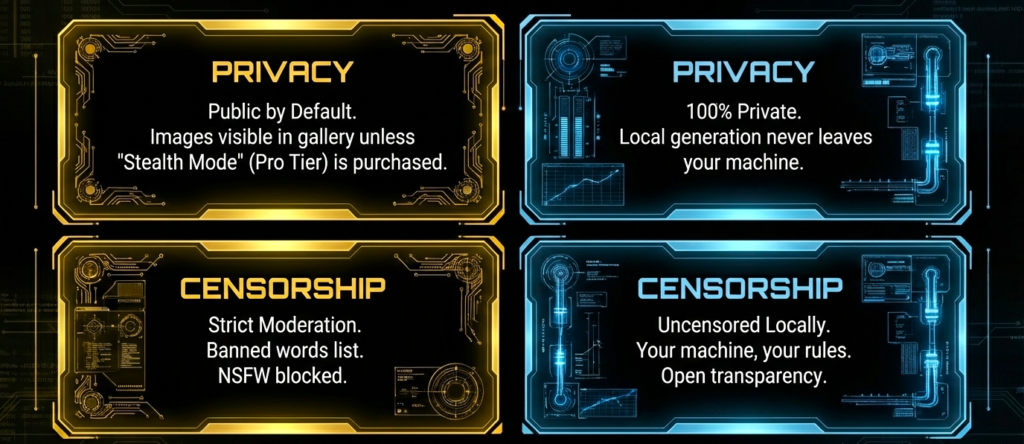
Midjourney runs on their servers.
Your prompts are processed in the cloud.
Generation happens remotely.
Stable Diffusion can run fully offline on your local GPU.
No prompt leaves your machine.
This is confirmed in Stability AI documentation and open source deployment guides.
If you are working with confidential product designs, internal brand visuals, or sensitive prototypes, local generation matters.
I once tested generating internal concept art for a mock startup idea.
With Stable Diffusion offline, I felt safer.
With Midjourney, I had to trust their infrastructure.
For enterprise use, many companies prefer on premise or controlled cloud environments.
Stable Diffusion supports that model.
Did You Know
- Stable Diffusion can be trained on custom datasets to emulate specific styles or brands.
- Midjourney uses hidden prompt enhancements that make outputs look richer than the raw text input.
- In one academic study, Stable Diffusion scored better than both Midjourney and DALL-E in generating realistic faces using FID metrics.
- Many artists say Stable Diffusion feels like a tool you tame, while Midjourney feels like a paintbrush that already knows how to paint beautifully.
Unique angle that most blogs ignore
Most articles compare image beauty.
That is surface level.
The deeper difference is dependency risk.
Midjourney is a centralized service.
Policy changes, pricing shifts, feature restrictions can happen at any time.
Stable Diffusion is open source.
Even if Stability AI changes direction, the model weights already released remain accessible.
That creates long term strategic stability.
If you build your workflow around Midjourney and they increase prices significantly, you absorb the cost.
If you build around Stable Diffusion, your cost depends mostly on compute.
That difference influences founders more than artists.
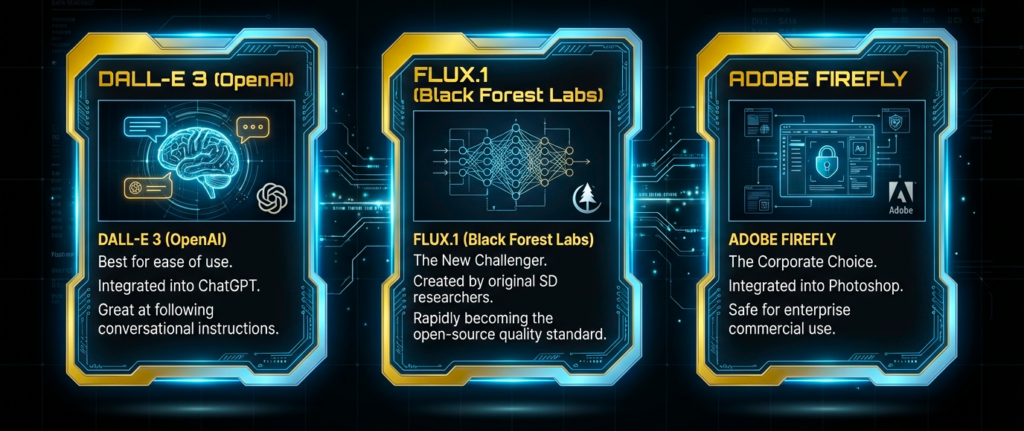
Stable Diffusion vs Midjourney quick comparison recap
Here is a straight comparison in plain language.
| Feature | Midjourney | Stable Diffusion |
|---|---|---|
| Open Source | No | Yes |
| Local Hosting | No | Yes |
| Cloud Based | Yes | Optional |
| Ease of Use | Very Easy | Medium to Advanced |
| Custom Model Training | No | Yes |
| Fine Tuning | No | Yes |
| API Level Control | Limited | Extensive |
| Automation Friendly | Low | High |
| Privacy Control | Server Based | Fully Local Possible |
| Learning Curve | Low | Higher |
These differences are reflected in official documentation and developer discussions across GitHub and Reddit communities.
Final verdict
Here is the direct answer people search for.
For creators who want instant high quality visuals, Midjourney is easier and faster.
For developers, startups, and builders who need control, automation, and long term flexibility, Stable Diffusion is the smarter foundation.
I personally use both.
Midjourney when I want fast inspiration.
Stable Diffusion when I want control, reproducibility, automation, or experimentation.
That hybrid workflow works extremely well in practice 😊
Your choice depends on what you value more.
Convenience or control.
Speed or infrastructure.
Art output or system ownership.
Answer that honestly and the stable diffusion vs midjourney debate becomes simple.
| If You Are… | Choose |
|---|---|
| A YouTube Thumbnail Creator | Midjourney |
| A Social Media Marketer | Midjourney |
| A Startup Founder Building AI Tools | Stable Diffusion |
| A Computer Science Student | Stable Diffusion |
| An Enterprise Team With Privacy Needs | Stable Diffusion |
| A Hobbyist With No GPU | Midjourney |