
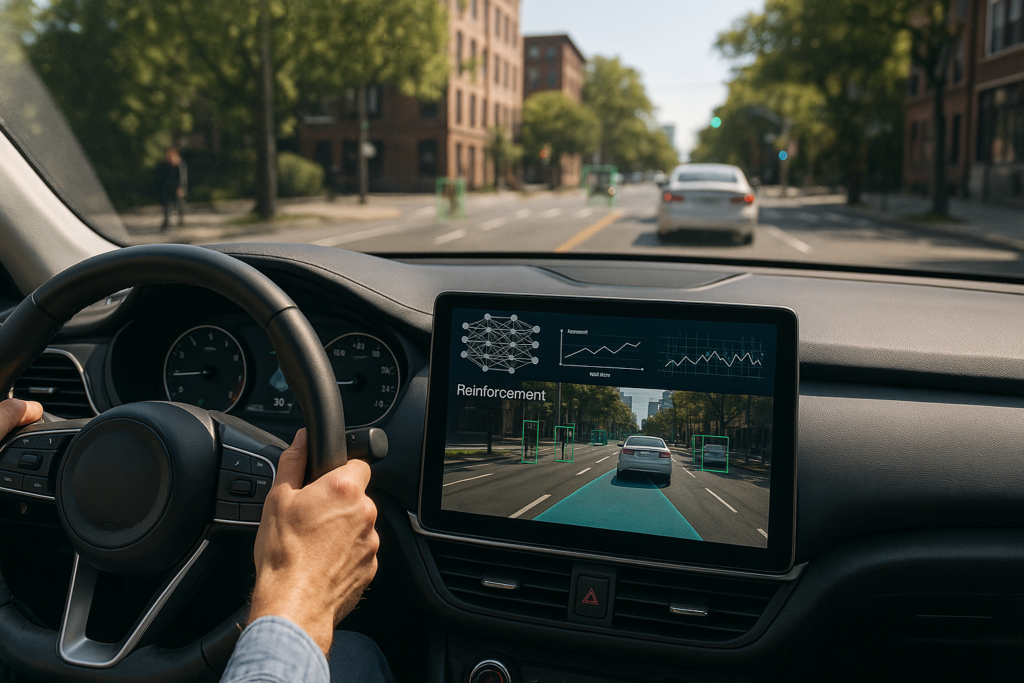
Imagine a car that teaches itself how to drive — not by being told what to do, but by trial and error, just like humans learning to parallel park. Sounds futuristic? It’s already happening.
Reinforcement Learning (RL) is quietly becoming the brain behind the next generation of autonomous vehicles — cars that don’t just follow rules, but learn to make decisions in unpredictable traffic.
Here’s the twist: while companies like Waymo, Tesla, and Cruise rely mostly on supervised learning and rules, RL is the only method that can truly adapt when something new happens on the road.
A recent IEEE study showed that RL-based driving policies improved lane-merging success rates by 37% and reduced collision risks by 25% in simulation. That’s not hype — that’s potential.
But here’s where most blogs get it wrong — they either romanticize RL as the “final solution” or dismiss it as unsafe. In reality, it’s somewhere in between. I learned that firsthand while exploring how machine learning systems evolve from static “pattern followers” into dynamic decision-makers.
- What is reinforcement learning – and why does it matter for self-driving cars?
- Which autonomous vehicle tasks should use RL – and which shouldn’t?
- How do you design RL for autonomous vehicles – key building blocks?
- What are the top algorithmic choices – and which ones are rising?
- Where do RL-based AV systems already succeed – and where do they fail?
- What are the biggest challenges and open research frontiers?
- Safety guarantees & verification
- Sample efficiency & scaling
- Sim-to-real transfer and generalization
- Robustness to noise, failures, adversarial attacks
- Generalization across geographies and cultures
- Mixed autonomy & human-AV interaction
- Hybrid systems: combining RL + symbolic rules + control theory
- LLM + RL integration (again)
- What’s a roadmap for someone building an RL-based AV system?
- FAQ – your burning questions, answered
What is reinforcement learning – and why does it matter for self-driving cars?
Short answer: RL is a framework where an agent learns by interacting with an environment, getting rewards (or penalties), and adjusting its behavior to maximize cumulative reward.
In the AV domain:
- The agent = the autonomous driving system (or a decision module).
- The environment = road, traffic, sensors, other vehicles, pedestrians.
- Actions = braking, accelerating, lane changes, steering, merging decisions.
- Reward = a signal combining safety, comfort, efficiency, legality, etc.
How does RL differ from imitation learning or supervised learning?
- Supervised / imitation learning mimics expert behavior from historical data. It can’t easily generalize to novel scenarios outside that data.
- RL allows exploration, adaptation, and learning from new experiences, making it suitable for dynamic, uncertain settings.
- But RL has its downsides: it can be sample-inefficient, unsafe in exploration, and opaque.
Where in the AV stack is RL a good fit?
RL is not for every part of a self-driving system. It fits best in modules that:
- Require sequential decision-making under uncertainty (e.g. merging, negotiating intersections)
- Benefit from long-term planning (anticipating downstream consequences)
- Face complex and dynamic constraints that are hard to handcraft rules for
It’s less suitable for perception (object detection, segmentation) or raw sensor fusion, which are well-handled by supervised deep learning.
The big question: can we combine the adaptability of RL with the reliability and safety required for real vehicles?
Which autonomous vehicle tasks should use RL – and which shouldn’t?
Question: When is RL the right approach, and when is it overkill (or dangerous)?

Tasks where RL has shown promise
- Behavioral decision-making (deciding to overtake, change lanes, or yield)
- Merging / intersection negotiation / ramp control
- Platooning (coordinating groups of vehicles)
- Multi-agent interactions (AVs negotiating among themselves or with human drivers)
Tasks better handled by conventional methods
- Low-level control (steering, throttle) in stable regimes
- Perception, object detection, sensor fusion
- Modules requiring strict safety guarantees or real-time deterministic constraints
Task risk budgeting – a fresh lens
I propose a task risk budget concept: for every module, assign how much “learning risk” (i.e. chance of exploring suboptimal or dangerous behavior) you can tolerate. High-risk modules (like lane changing near pedestrians) may require more constraints or hybrid rule-based fallbacks. Lower-risk modules may allow more aggressive RL exploration.
By thinking in terms of risk budgets, designers can better allocate where RL is safe to deploy and where fallback logic or conservative design must dominate.
How do you design RL for autonomous vehicles – key building blocks?
Question: What goes into making a real RL system for an autonomous car?
State representation: what the agent sees
- Fusing sensor inputs (lidar, camera, radar) into a compact but informative state
- Incorporating traffic context, positions and velocities of nearby actors
- Including memory / history when full Markov state is unavailable
Action space: what the agent does
- Discrete actions (e.g. “change left”, “go straight”)
- Continuous control (steering angles, acceleration)
- Hybrid actions (decision + control)
- The choice depends on task complexity and safety constraints
Reward function design: the guiding hand
Crafting the reward is delicate. Examples of terms:
- +ve reward for progress toward goal or smooth driving
- –ve penalty for collisions, near-misses, illegal maneuvers
- Penalties for jerk, comfort violations, excessive acceleration
- Safety constraints (hard penalties or disallowed actions)
The trick: avoid reward hacking (agent finds weird shortcuts) or overfitting to training scenarios.
Sample efficiency & exploration strategies
RL in driving suffers from needing huge amounts of data. Solutions:
- Use off-policy learning, replay buffers
- Curriculum learning (start easy, gradually harder)
- Domain randomization (vary environment)
- Offline RL using logged driving data
Simulation vs real deployment; bridging the sim-to-real gap
- Train in high-fidelity simulators (CARLA, LGSVL, etc.)
- Use domain randomization to vary physics, sensors
- Transfer learning, fine-tuning with real data
- Adaptive modules that monitor divergence between sim and reality
Safety mechanisms & fallback logic
- Constrain action space (limit accelerations, enforce safety rules)
- Use barrier functions or control-theoretic safety layers
- Maintain a fallback rule-based module or safe policy
- Real-time monitoring & kill-switch
What are the top algorithmic choices – and which ones are rising?
Question: Which RL algorithms work best (or have potential) for AV tasks?

Model-free vs model-based RL
- Model-free: simpler, direct mapping from state to action
- Model-based: builds a model of environment dynamics and plans—often more sample-efficient
Popular algorithm families
- Policy gradient / actor-critic (e.g. PPO, SAC, DDPG)
- Q-learning variants (e.g. DQN, double DQN)
- Distributional RL, risk-sensitive RL
- Hierarchical RL (skills, options) for scaling complexity
Safe and offline adaptations
- Safe RL algorithms (constrained policy updates)
- Offline RL (learning from logs)
- Adversarial RL / robust RL (learning policies resistant to disturbances) arXiv+2ScienceDirect+2
Multi-agent RL & traffic interaction
When AVs must negotiate with human vehicles, use multi-agent RL frameworks. One paper demonstrates robustness and adaptability of cooperative AVs in mixed-autonomy traffic. arXiv
Newer frontier: LLM + RL for vehicle decision-making
A relatively unexplored direction is combining large language models (LLMs) or causal reasoning modules with RL to provide better abstraction or interpretability. For example, internal LLM-based “reasoners” could evaluate natural-language rules or high-level policies, while RL handles low-level execution.
One recent work in multi-agent RL uses causal disentanglement + graph RL to improve decision-making in traffic interactions. arXiv
This hybrid approach could allow richer abstractions, better interpretability, or even dynamic safety constraints.
Where do RL-based AV systems already succeed – and where do they fail?
Question: What’s working in RL for AVs—and where do things break?
Success stories & case studies
- In simulation, RL agents have learned lane changing, merging, overtaking tasks and improved throughput or safety metrics.
- Autonomous racing research shows that RL can push vehicles to near-handling limits while respecting constraints. arXiv+3MDPI+3ResearchGate+3
- Robust or adversarial RL approaches reduce collision rates under disturbances. arXiv
Metrics improved
- Lower collision or near-miss rate
- Better traffic flow / throughput
- Smoother driving (less jerk)
- Capability to generalize across slight variations
Failure modes & weaknesses
- Catastrophic exploration: agent tries dangerous actions
- Reward hacking: finds loopholes in reward definitions
- Simulation bias / overfitting: fails in real world
- Lack of interpretability: hard to understand why agent acts
- Corner-case brittleness: fails on rare but critical scenarios
Corner-case robustness – a critical underexplored angle
One unique angle: how do RL policies cope with extreme or adversarial edge cases? The “corner cases” (rare but dangerous scenarios) are underrepresented in typical training. A method called DR2L dynamically surfaces harder cases to the agent during training, improving robustness. arXiv+1
But more work is needed: evaluating agents under adversarial, sensor-fault, or malicious disturbances is often overlooked.
What are the biggest challenges and open research frontiers?
Question: What holds RL for AVs back—and where is research headed?
Safety guarantees & verification
You can’t send out a car and hope it doesn’t crash. We need formal guarantees over learned policies, which is still largely unsolved.
Sample efficiency & scaling
Collecting real driving experience is expensive. Bridging that with simulation and offline data is a major hurdle.
Sim-to-real transfer and generalization
Even if a policy works in a simulator, it may fail on real roads due to environment mismatch.
Robustness to noise, failures, adversarial attacks
Sensors fail, conditions change, attacks may happen. RL policies need to tolerate these. ScienceDirect
Generalization across geographies and cultures
Driving rules, behaviors, road geometries differ by region. A model trained in one city may fail in another.
Mixed autonomy & human-AV interaction
When human drivers are in the loop, RL must adapt to unpredictable, irrational agents. Multi-agent RL and social preference modeling are active fronts. arXiv
Hybrid systems: combining RL + symbolic rules + control theory
Pure RL may be too risky for some tasks. Hybrid architectures (RL deciding high-level, rule-based or classic controllers managing low-level) will likely dominate.
LLM + RL integration (again)
Emerging idea: use LLMs or causal reasoning modules alongside RL to interpret rules, propose new subgoals, or flag unusual states. This might help with interpretability and strategic reasoning.
What’s a roadmap for someone building an RL-based AV system?
Question: How should you roll out a real system with RL in vehicles?
- Prototype in simulator
- Start with simpler driving environments
- Use curriculum learning, domain randomization
- Test safety constraints
- Shadow mode / offline testing
- Run RL policy in parallel (non-acting) in real cars
- Compare decisions vs rule-based system
- Limited real-world deployment
- Only allow RL module in controlled settings
- Monitor, log, override via safe fallback
- Continuous validation and fallback guardrails
- Evaluate policy frequently
- Use fallback policies or kill switches
- Iterate
- Adjust rewards, constraints
- Expand task complexity
- Introduce harder corner cases
- Scaling & deployment
- Monitor real-world transfer drift
- Use federated learning, safe updates
The key: incremental risk exposure, strong guardrails, and constant monitoring.
FAQ – your burning questions, answered
Q1: Is reinforcement learning ready for real AVs today?
No — we’re not there yet. RL works well in simulation and controlled trials, but full deployment at scale still faces safety, explainability, and generalization challenges.
Q2: How do you prevent an RL agent from doing “crazy stuff” in corners?
Use safety constraints, fallback policies, barrier functions, and constrained RL methods. Also train with curriculum and adversarial cases.
Q3: How much data or simulation time is needed?
Often millions of interactions. That’s why sample efficiency, offline data, and transfer learning are critical.
Q4: Can RL handle extremely rare accident scenarios?
Not reliably—unless you deliberately inject such corner cases into training (e.g. via DR2L). Rare events remain a hard open problem.
Q5: Do I need a background in control theory to use RL?
It helps. Understanding dynamics, constraints, stability, and fallback control is very useful when combining RL with safety modules.
Q6: What’s better: RL or imitation learning?
They serve different purposes. Imitation is safer and data-efficient for known behaviors. RL helps generalization and novel scenario handling. A hybrid approach is often best.
Q7: How do you debug or interpret RL policies?
You can use visualization (state-action mapping), sensitivity analysis, counterfactuals, or integrate causal reasoning modules. But full interpretability is still weak.
Q8: Will regulators ban learning-based driving policies?
Possible. Many governments require explainability, auditability, and guarantees. That’s why combining RL with rule-based or certified modules is more realistic.