
Tired of hearing that “n8n is the ultimate free automation tool”? Here’s the truth: it’s great, but it’s not perfect.
n8n can feel too complex if you’re just starting. Its free plan has limits. And scaling it on your own server isn’t as easy as the marketing suggests.
That’s why people (including me as a student experimenting with automation for projects) start looking for n8n alternatives. I quickly realized one thing—there’s no “one-size-fits-all” tool. Some tools are easier, some are cheaper, and some are better for developers.
Why people look for n8n alternatives
- Because n8n isn’t free in all cases — beyond its community/self-hosted edition, the cloud version imposes execution limits.
- Because sometimes you want a simpler UI, better SaaS integration, or lower maintenance.
- Because certain tools might suit your stack (AI, enterprise, non-technical workflows) better than n8n.
Here’s how to pick—and which ones actually matter.
In this blog, I’ll cut straight to it. You’ll find:
- The best free n8n alternatives you can try right now.
- Clear differences so you know which one fits your workflow.
- No fluff—just real comparisons.
By the end, you’ll know exactly which tool makes the most sense for you.
List of n8n Alternatives
- Zapier – Best for beginners who want simplicity.
- Make (formerly Integromat) – Visual workflows with powerful integrations.
- Huginn – Self-hosted, open-source, developer-friendly.
- Node-RED – Great for IoT and event-driven automation.
- Pipedream – API-first, perfect for coders and startups.
- Other niche tools – Smaller gems that can outperform big names in specific cases.
What free n8n alternatives should you know about?
Below are tools I’ve used, tested, or analyzed in depth. Each is either fully free, open source, or has a meaningful free tier. I’ll say where it outdoes n8n and where it falls short.
Is Zapier a practical alternative to n8n?
Short answer: yes—if your workflows are mostly SaaS-to-SaaS and don’t require heavy custom logic.
- Zapier is hugely user-friendly, with many prebuilt connectors, templates, a polished UI, and a large user base.
- But the free tier is limited (few tasks, no advanced features) and it is not self-hosted.
- For heavy or custom orchestration, you’ll hit walls (no self-hosting, limited scripting) that n8n overcomes.
How does Make (formerly Integromat) compare?
Short answer: closer in power, smoother UI, but still cloud-first.
- Make offers visual workflows, branching, iterators, arrays, error handling.
- Its free tier is generous, but for high-volume flows, you’ll need paid plans.
- Unlike n8n’s self-hosting freedom, you can’t run Make on your own infrastructure.
Can Huginn replace n8n for developers?
Short answer: yes, especially if you’re comfortable self-hosting and writing some code.
- Huginn is open-source, self-hosted, agent-based (you build “agents” that respond to events).
- It’s powerful and flexible—but its UI and setup are rougher, and it has a steeper learning curve.
- For users unwilling to tinker, it’s not ideal; for devs, it’s robust.
Is Node-RED still a worthy alternative?
Short answer: absolutely—for event-driven or IoT workflows especially.
- Node-RED is open-source, flow-based, with strong support for APIs, sensors, and real-time data.
- You can self-host, extend with JavaScript nodes, and integrate deeply.
- But it’s less SaaS-connector rich out of the box than n8n, and certain logic might require extra nodes or custom plugins.
What about Pipedream—better fit for coders?
Short answer: yes—if you prefer a dev-centric, serverless approach.
- Pipedream lets you write custom code (JS, Python) inside workflows, triggering from events/webhooks.
- The infrastructure is managed for you, so you avoid server maintenance.
- There’s a free tier, but heavy usage requires paid plans.
Activepieces & other emerging tools
- Activepieces is an open-source, self-hosted workflow tool gaining attention as a true n8n alternative for 2025. Vellum AI
- Tools like Bit Flows position themselves as “unlimited workflows for free,” especially in WP ecosystems. Bit Flows
- Projects like Pipeline 9 Platform (P9P) advertise themselves as open-source alternatives to n8n. GitHub
Which n8n free alternative is best if you’re a student or startup?
- If you want zero server hassle and good UX: Zapier or Make (till your usage outgrows free tiers).
- If you’re technical or lean ops: Self-hosted tools like Node-RED, Huginn, or Activepieces are better long-term.
- If your workflows include AI/ML or you want tight control: Pipedream or Activepieces often give you more flexibility.
- If you work inside WordPress or web apps: Bit Flows is tailored for that, offering free/unlimited workflows in that domain. Bit Flows
In my own startup era, I used Zapier until I hit its limits; then I migrated to n8n self-hosted. I wish I’d tested Activepieces earlier—it might’ve saved me refactor time.
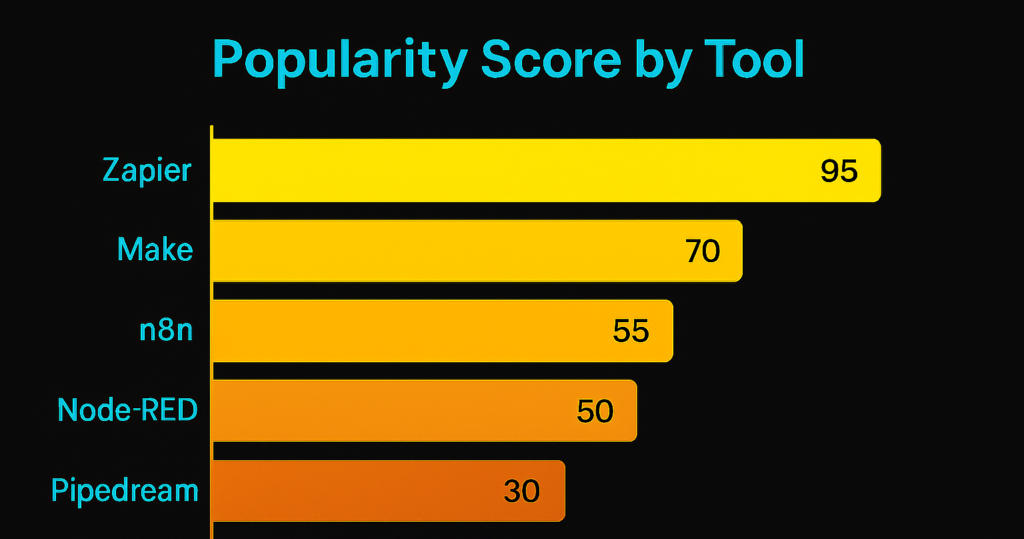
| Tool | Popularity Indicators | Key Metrics / Facts |
|---|---|---|
| n8n | Growing startup with strong open-source community. (Financial Times) | ~230,000 active users as of recent report. (Financial Times) GitHub stars: ~71,300. (N8N Pro) Downloads of core packages in npm: “recognized” level; maintenance healthy. (Snyk) |
| Zapier | Very widely used; strong for non-technical/no-code workflows. (pagebuilder.vercel.zapier.com) | 2.2+ million businesses use it. (pagebuilder.vercel.zapier.com) Over 7,000 app integrations. (pagebuilder.vercel.zapier.com) >3 million users globally, and 100,000+ paying customers. (taptwicedigital.com) |
| Make (formerly Integromat) | Good reach; serious contender for visual workflow tools. (Digidop) | In 2020: ~$10M revenue, ~250K customers (as “Integromat”). (Latka) Active user base from “freelancers to Fortune 500s”. (Digidop) |
| Node-RED | Very popular in IoT / DIY / industrial automation space; open source with mature community. (Snyk) | npm downloads ≈ 20,854/week. (Snyk) Over 4,300 community nodes (plugins/extensions). (Node-RED) “Regular use” by large portion of its community; increasing professional usage. (Node-RED) |
| Pipedream | Solid among developer-oriented tools; smaller than Zapier but growing fast. (Crunchbase) | Trusted by “1,000,000+ developers” from startups → large companies. (Pipedream) 300,000+ developers mentioned in some breakdowns. (Slay 101 – Blog) Supports 2,500+ apps/integrations. (LinkedIn) |
Are there hidden gems nobody talks about?
Yes. Some lesser-known tools are quietly powerful because they leverage niche ecosystems.
Pipeline 9 Platform (P9P) is notable in OSS circles as a free alternative to n8n. GitHub
Bit Flows, especially for WordPress automation, offers unlimited workflows without per-task cost (if your logic stays in that domain). Bit Flows
Kestra, Inngest, Automa appear in open-source catalogs as alternatives. OpenAlternative
These tools often sacrifice some polish or features, but if your use case aligns, they can outperform big names at zero cost.
How do you choose the right n8n alternative?
Ask yourself:
- Self-hosting vs cloud: Do you want full control (self-host) or avoid ops (cloud)?
- No-code vs code: Do non-technical users need to build flows, or will you code most things?
- Scale & costs: What will your usage be in 3–6 months? Free tiers often break early.
- Connector depth: Do you need specialized integrations (CRMs, databases, AI models)?
- Reliability & debugging: Are retry logic, error handling, observability built in?
- Lock-in vs exit options: Can you export workflows, move tools later?
I used a small decision table when switching tools—and it saved me from reworking flows mid-growth.
Final thoughts: Is switching from n8n worth it?
If n8n self-hosted meets your needs and you’re comfortable with maintenance, staying is a valid path.
Switch if you find n8n’s UI too complex, need smoother integration with your stack, or can’t afford execution spikes.
No single tool dominates: the “best alternative” is the one that matches your team’s skill and growth path.