
AI isn’t one thing anymore. It’s a battle between traditional AI that analyzes and predicts—and generative AI that creates.
The stakes? Trillions of dollars in future value. McKinsey projects generative AI alone could add $4.4 trillion annually to the global economy. Yet, MIT found 95% of enterprise AI projects fail to deliver measurable impact.
So the obvious question for any decision-maker is this: Which approach will actually dominate the future—and which one should you bet on?
I remember testing a generative AI system on compliance work. It wrote confident answers… but one was completely made up. A mistake like that could cost millions. That’s when it hit me: the hype is huge, but not every problem is built for generative AI.
This post will cut through the noise. You’ll learn where traditional AI still rules, where generative AI shines, and what businesses like yours should actually prepare for.
By the end, you’ll know exactly how to approach this “Generative vs Traditional AI” debate without wasting time, money, or trust.
- What do we actually mean by “Traditional AI” vs “Generative AI”?
- Where does traditional AI still shine in today’s business world?
- What does generative AI unlock that traditional AI never could?
- Are businesses replacing traditional AI with generative AI—or using both?
- Which approach gives better ROI for businesses right now?
- What’s holding each approach back from dominating the future?
- So, which one will truly dominate the future of AI in business?
What do we actually mean by “Traditional AI” vs “Generative AI”?
What is “traditional AI,” really?
Traditional AI refers to systems built for prediction, classification, optimization—think churn prediction, fraud detection, routing logistics.
These models are often supervised, rule-based, or use classic machine learning approaches like linear models, decision trees, or SVMs.
They’re trusted, explainable, and optimized for accuracy and stability.
And generative AI?
Generative AI creates new content—text, images, code, designs—by learning patterns from large datasets like LLMs or GANs.
It’s less about “what’s likely” and more about “what’s possible.” (sandtech.com)
Are we oversimplifying by pitting them against each other?
Yes, to a degree.
The line is blurred: some “traditional” models embed generative elements, and generative systems often rely on predictive models.
But for decision-makers, the distinction helps: one is about analysis, the other about creation.
Where does traditional AI still shine in today’s business world?
Which problems are best handled by traditional AI?
Tasks where outputs must be precise, predictable, and explainable—credit scoring, supply chain forecasting, anomaly detection.
If failure costs are high, you lean traditional.
Why do enterprises stick with it?
Because it’s stable, interpretable, lower risk.
They’ve built processes, compliance, and guardrails around it.
Swapping it out is expensive and risky.
Is traditional AI cheaper, safer, or just more predictable?
All three.
The incremental costs are known.
When a model’s performance degrades, you understand why.
With generative models, hallucinations or model drift are harder to catch.
I remember working with a financial-services client.
They tried swapping out their fraud detection model for a generative variant.
The gains were modest, but the regulatory scrutiny spiked.
They backed off and returned to a hybrid architecture.

What does generative AI unlock that traditional AI never could?
How does generative AI create “net new” content?
By modeling data distributions and sampling from them.
In language, a model learns which words tend to follow which, then writes new sentences that “sound right.”
In design, it explores a space of shapes and suggests entirely new forms.
Why are companies experimenting with it now?
Because it’s powerful for content, design, ideation, personalization.
Case in point: Ferrari has used generative AI to accelerate design cycles and deliver personalized experiences. (aws.amazon.com)
Also, Klarna shaved $10 million off marketing costs by automating image generation. (reuters.com)
What’s the hidden cost (bias, hallucination, compute)?
Generative models can hallucinate, embed bias from training data, and cost much more in compute.
Governance and auditing are also harder.
I ran a prototype where the model hallucinated regulatory language in a compliance document.
A human would catch it, but the team didn’t.
That risk made us pause.
Are businesses replacing traditional AI with generative AI—or using both?
Do enterprises see generative AI as complement or competitor?
Mostly complement.
Very few are tossing out existing systems wholesale.
The trend is augmentation: generative AI handles creative, generative tasks; traditional AI handles the backbone.
How are companies mixing the two?
In real workflows: use generative AI to draft proposals, then traditional models to score risk or flag anomalies.
Or use generative for data augmentation, traditional for final classification.
Some ERP systems now embed generative agents to plan tasks atop classic modules.
FinRobot architecture in finance lowered error rates by 94 %. (arxiv.org)
Is there a framework for deciding when to use which?
Yes:
- Task type: If outcome must be deterministic → traditional.
- Risk profile: High-stakes → traditional.
- Data availability: Generative needs large, clean datasets.
- Governance readiness: If you lack model auditing, stick with traditional for now.
Which approach gives better ROI for businesses right now?
How do cost, scalability, and risk differ?
Generative AI has higher upfront compute and risk, but the upside per unit is high if it works.
Traditional AI scales more predictably.
What metrics matter when comparing ROI?
Time and cost saved.
Revenue uplift or new value created.
Error reduction and risk mitigation.
Adoption and trust.
Operational cost to maintain.
Are startups and Fortune 500s making different bets?
Yes.
Startups bet heavily on generative models to carve unique value.
Big enterprises pilot cautiously, layering generative into existing systems rather than replacing them.
A McKinsey report estimates generative AI could add trillions in value across the global economy. (mckinsey.com)
For skilled workers, exposure to generative AI boosted performance by ~40 % in one controlled experiment. (mitsloan.mit.edu)
What’s holding each approach back from dominating the future?
Regulation: bigger threat to generative?
Yes.
Creating content raises IP, defamation, and privacy risks.
Regulators will constrain generative earlier.
Traditional AI’s risks, like bias and discrimination, are more understood.
Scalability bottlenecks for generative?
Definitely.
Compute demands, latency, and model maintenance scale nonlinearly.
Traditional models often scale more linearly.
Is traditional AI in danger of being seen as “outdated”?
Possibly.
Outdated does not mean useless.
Traditional will remain the backbone for many mission-critical systems.
MIT recently found 95% of generative AI projects fail to deliver measurable business impact, often due to integration and misuse, not bad models. (tomshardware.com)
So, which one will truly dominate the future of AI in business?
Why the real answer might be “neither” (or both)?
Because dominance isn’t monolithic.
The future is hybrid: generative + traditional models working together.
Creative systems generate.
Analytical systems validate and control.
Is the future “hybrid AI” blending both worlds?
Absolutely.
We’ll build systems that self-generate, self-audit, self-optimize by combining generative creativity and predictive discipline.
Architectures like agentic AI already embed both. (www2.deloitte.com)
What should decision-makers prepare for in the next 5 years?
- Invest in governance, audit frameworks, model explainability
- Build data infrastructure strong enough to train generative systems
- Start small pilots on generative use cases, but integrate them with existing AI
- Train your team not just in ML, but in prompt engineering, risk assessment, human-AI workflows
- Keep a long view: hype is high, but only the 5 % that execute well (clear use case + integration + governance) will succeed.
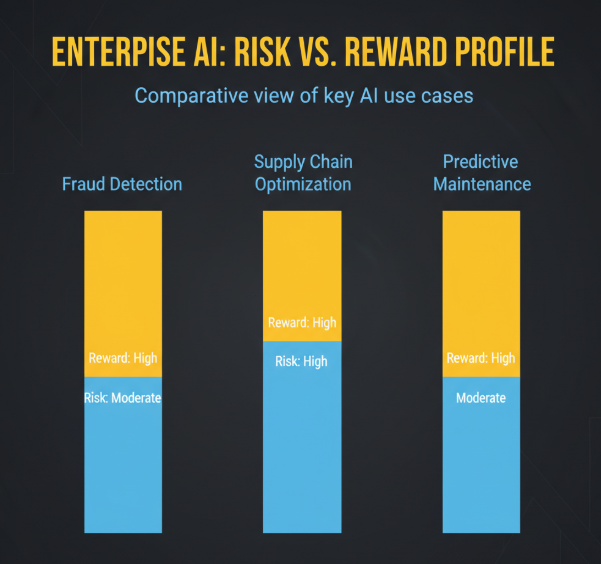
Bottom line:
Generative AI won’t replace traditional AI.
It will amplify it.
The winners are those who can blend creation with control, exploit scale without losing trust, and treat AI as a core part of their business.