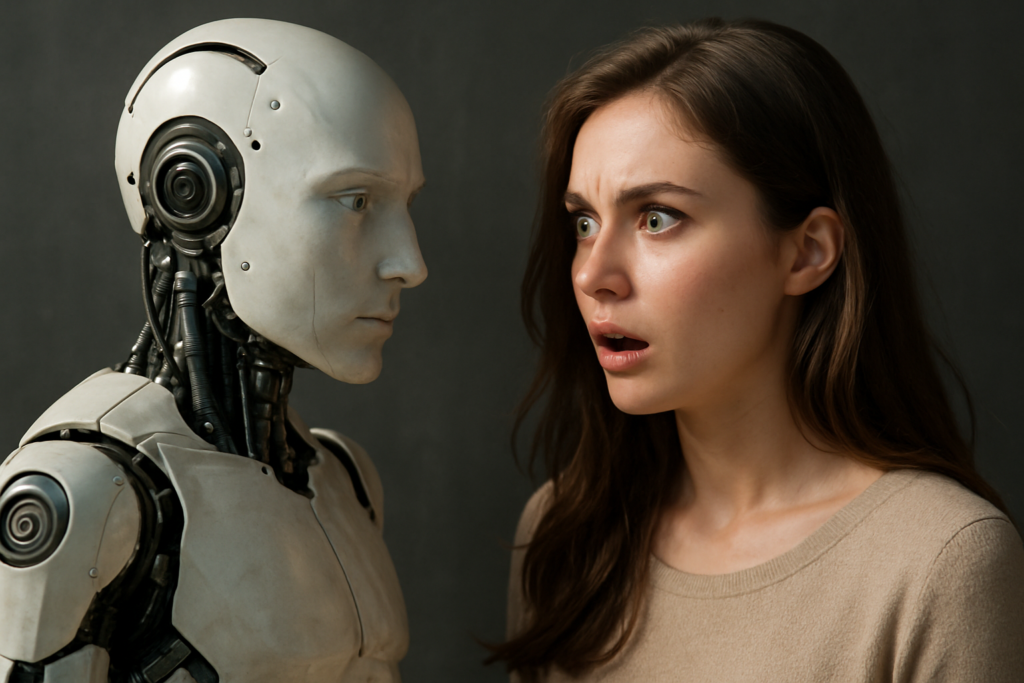
You’ve probably heard people say, “AI is about to replace humans.” But is that really true? The truth: AI and human intelligence are completely different—not just in how they work, but in what they even are.
Here’s a fact: In 2024, AI solved complex chess problems in seconds, but still can’t understand sarcasm or make ethical decisions like a 5-year-old. Crazy, right?
Back in 1966, the BBC asked a bunch of schoolkids in the UK what they thought life would be like in the year 2000. And man… some of their answers were weirdly accurate — others, hilariously off.
Some kids thought the future would be super bleak — with atomic bombs flattening cities and people basically living in fear. Honestly, that kind of nuclear anxiety made sense back then during the Cold War. Still hits close to home sometimes with today’s headlines.
One boy imagined a world run by machines, where humans would be so dependent on tech that we’d even have funerals for dead robots. Wild, right?
A few were oddly specific — like one who predicted meat and eggs would come from “battery units” instead of farms. That’s exactly how factory farming works now. According to Sentience Institute, over 99% of U.S. livestock is raised in factory farm conditions. They nailed that one.
Another kid said we’d all be living in tiny apartments stacked high up, not houses — because of overpopulation. Have you seen Hong Kong, New York, or Dhaka lately? He wasn’t wrong. Some cities have “coffin apartments” now. That prediction felt a little too real.
But then, One talked about cabbage pills replacing meals. Another said there’d be robots fighting wars on the moon. A little too much sci-fi there 😂.
Then there was a sharp kid who talked about automation taking over jobs, rising unemployment, and needing to control population growth to avoid chaos. Legit dystopian insight — and kind of what’s happening with AI right now. A recent Goldman Sachs report says AI could replace 300 million jobs globally. This kid saw it coming in 1966.
What I’m trying to say is that You don’t need to be scared. The world has seen bigger threats like Nuclear Weapons in the past, but all our pessimistic predictions on new technologies and inventions never really come true. At the end of the day, we enjoy the benefits they bring(some disasters like chernobyl do occur though).
I remember asking an AI chatbot for career advice once. It gave me a logical, data-driven answer—but missed the part where I actually cared about my passion. That’s when I realized: AI might be smart, but it’s not human.
If you want to understand how these two forms of intelligence differ—and why that matters for your job, your business, and your future—keep reading. This isn’t about hype. It’s about facts.
- What Do We Actually Mean by “Intelligence”?
- Core Differences Between AI and Human Intelligence
- What Humans Still Do Better Than AI (and Likely Will for a Long Time)
- What AI Already Does Better Than Humans
- The Overlooked Angle: AI Has No Stake in the Outcome
- Can AI Ever Replicate Human-Like Intelligence?
- Final Thoughts: Should We Even Be Comparing the Two?
What Do We Actually Mean by “Intelligence”?
Human intelligence isn’t just about solving math problems or scoring high on IQ tests. It’s messy, emotional, creative, biased, and sometimes flat-out irrational—and that’s exactly why it works so well in the real world.
When I forgot my laptop before an important client pitch, I somehow stitched together the entire presentation from memory, improvising, connecting dots, and reading the room. That’s not “memory retrieval.” That’s human intelligence—adaptable, emotional, and deeply contextual.
On the flip side, AI intelligence isn’t actually intelligence. It’s pattern recognition at scale. It doesn’t “understand” anything—it just calculates the most probable output.
As AI researcher Gary Marcus said, “AI today is like a supercharged autocomplete—it has power, but no real understanding.” That’s a brutal but fair callout.
I’ve seen GPT-4 generate code that looks perfect but crashes instantly because it misunderstood the context. That’s the difference between knowing and calculating. 🤖
So let’s get something straight. AI ≠ Human intelligence. They’re not two flavors of the same thing.
One is organic, shaped by evolution, capable of feeling and abstract thought. The other is synthetic, shaped by training data, incapable of real understanding or agency.
A 2023 study by MIT (https://news.mit.edu/2023/ai-versus-human-intelligence-study-0308) confirmed this with experiments showing that humans outperform AI in ambiguous, open-ended tasks by over 40%, especially in scenarios that require ethical judgment, emotional nuance, or long-term strategy.
Now, why does this comparison matter more today than it did 10 years ago? Because people are starting to trust AI with real decisions—medical advice, hiring, sentencing, financial planning.
That’s dangerous. AI doesn’t have values. It doesn’t care if it’s wrong.
I remember a friend who used ChatGPT to help pick investments; it gave logical-sounding advice but ignored macro-economic factors completely. He lost 12% in two weeks.
And here’s the real kicker: intelligence without responsibility is just computation. That’s where AI fails.
It can mimic, simulate, even outperform in certain tasks—but it has zero accountability, zero motivation, and zero stakes.
Meanwhile, a tired doctor pulling a night shift in an ER still makes judgment calls no AI can.
Because humans feel pressure, fear, compassion. We care about the outcome.
AI just finishes the prompt.
So next time someone asks you, “Can AI ever be as smart as us?”—you can say: “It already is, but only if the question has one right answer.”
Anything more? It’s still a baby with a calculator.
Core Differences Between AI and Human Intelligence
AI and human intelligence are fundamentally different, not just in how they process information but in why they process it.
Humans think to survive, evolve, connect, and understand meaning.
AI processes data to maximize accuracy and efficiency, without any awareness, emotion, or purpose.
Biological vs. Artificial Processing
Humans use neurons, powered by bioelectrical signals, to process thoughts.
The brain has around 86 billion neurons and consumes just 20 watts of energy—about the same as a dim lightbulb (Scientific American).
In contrast, AI runs on silicon, powered by GPUs that can consume hundreds of watts just to match basic pattern recognition tasks.
When I was training a simple image classifier using TensorFlow on my laptop, the fan sounded like a jet engine—and all it did was recognize digits. 🤯
That’s the tradeoff: brute force vs. elegant biology.
Learning: Experience vs. Data
Humans learn from life—mistakes, context, nuance.
AI learns from structured data, often labeled, and in huge amounts.
For example, GPT-4 was trained on 13 trillion tokens (OpenAI technical report).
Yet, if I told it a joke about my cat and a broken Wi-Fi router, it wouldn’t laugh—or even know why it was funny.
I once made a wrong turn while driving and realized I had learned something new about the neighborhood.
AI can’t do that.
It can’t generalize from one-off events without data patterns.
It remembers everything, but understands very little.
Adaptability: Chaos vs. Structure
Humans shine in chaos.
We can make decisions with limited or contradictory info—AI struggles with that.
A 2023 study by MIT CSAIL showed that AI performance dropped by 70% when test data slightly deviated from its training distribution (MIT CSAIL study).
I remember building a chatbot for a campus project; it failed completely when I threw in sarcasm or slang.
Humans? We roll with ambiguity.
AI breaks.
Creativity: Spontaneity vs. Probabilistic Output
People love saying “AI is creative.”
It’s not.
It’s statistically recombinant.
It predicts what looks like creativity.
I once asked ChatGPT to write a poem about coffee and heartbreak—it was good, but also… soulless.
No lived pain, no memories.
Just wordplay.
Neuroscientist Anil Seth puts it bluntly: “AI doesn’t dream, it doesn’t imagine, it computes.”
Real creativity is when I turned my heartbreak into code that generated sad playlists.
AI doesn’t feel, so it can’t surprise us with truly novel insight—it reshuffles.
Decision-Making: Emotion vs. Logic
Humans use emotion as a feature, not a bug.
Emotions guide morals, trust, and instinctive judgment.
AI uses cold logic—which isn’t always good.
Think of the 2016 COMPAS algorithm used in U.S. courts—it rated Black defendants as higher risk than white ones for the same crimes, due to biased training data (ProPublica Report).
I’d rather trust a judge with a conscience than a machine with math.
We feel guilt.
AI never will.
In short: AI is fast, scalable, and tireless.
But humans are intuitive, adaptable, creative, and aware.
That’s a gap no amount of data can bridge—for now.
What Humans Still Do Better Than AI (and Likely Will for a Long Time)
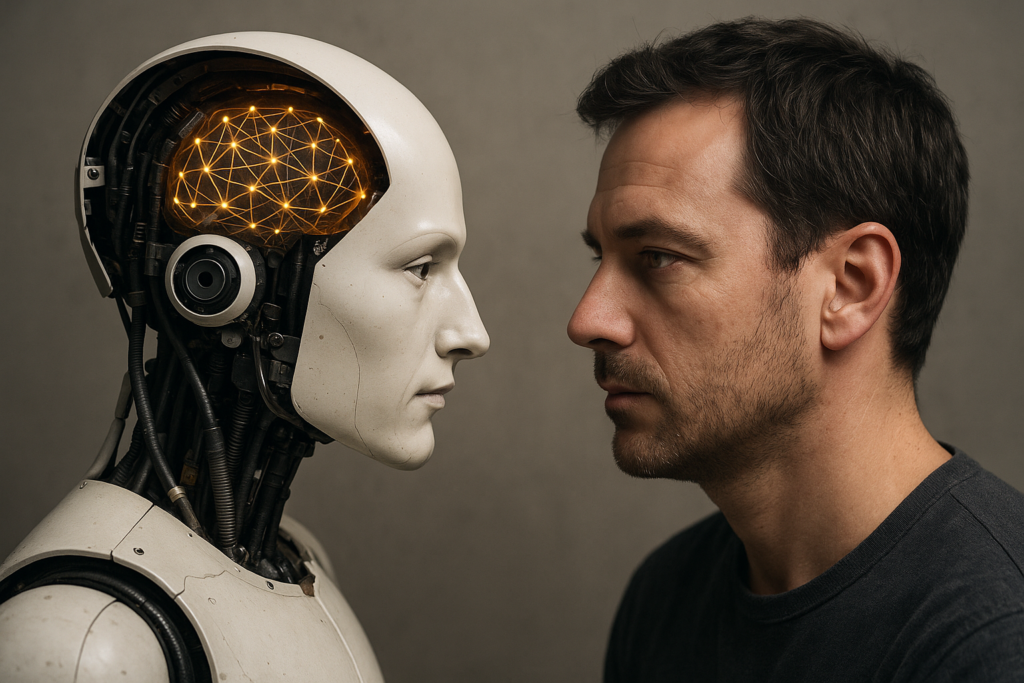
Humans beat AI in meaning, emotion, and real-world adaptability.
Let’s be clear: AI doesn’t understand anything—it processes.
That’s a massive difference.
You can feed GPT-4 or Gemini 1.5 a poem about grief, and it might describe the metaphor.
But it won’t feel the loss.
When my father passed away last year, no AI tool helped me write that eulogy—it was raw memory, emotions, and meaning stitched into words.
That’s human intelligence.
It’s personal, messy, and deeply rooted in lived experience.
In contrast, AI lacks this context.
It doesn’t know joy, fear, guilt, or love—it only maps words to likely next words.
Cognitive scientist Gary Marcus put it well: “Deep learning is not deep understanding.”
And that’s where humans win—especially in abstract reasoning or when dealing with contradictions.
If someone tells you “I’m fine” while crying, you know they’re not fine.
AI? It’ll take that sentence at face value and move on like an emotionally tone-deaf robot.
Now, here’s where it gets even more important—humans have stakes.
AI doesn’t.
I remember working on an automation system for fraud detection during my internship, and the AI flagged a genuine transaction by a cancer patient traveling for emergency surgery.
The algorithm didn’t “care,” but we did.
Humans had to override it.
Why? Because only we understood what was actually at stake.
According to the 2023 Stanford Artificial Intelligence Index Report, 62% of AI errors in critical systems still require manual correction due to “lack of contextual awareness.”
Another big edge: intrinsic motivation.
We pursue goals because we want to.
I didn’t learn programming because someone trained me with 10,000 code snippets.
I stayed up till 3 AM debugging a Flask app because I was obsessed with getting it right.
That kind of irrational dedication? AI doesn’t have it.
It’ll “optimize” whatever you feed it, but it won’t obsess, doubt, or dream. 🤖❌💭
Creativity is another myth AI has co-opted.
Yeah, it can remix Drake’s lyrics into a new song or generate 50 ad variations.
But is that true creativity? Not really.
It’s glorified copy-paste at scale.
I once asked ChatGPT to write a poem about loneliness in Dhaka traffic—what it gave me was technically correct, but emotionally flat.
No smell of smog.
No rickshaw bells.
No existential crisis of being stuck in Banani for 45 minutes with dead air and dead dreams.
Humans create from pain and presence.
AI creates from probability.
Even zero-shot reasoning—like solving new problems with zero context—is a human thing.
AI performs well in structured logic tests but fails spectacularly in open-ended tasks.
A 2024 MIT study found that humans outperformed GPT-4 by 41% in dynamic problem-solving scenarios where task rules were unclear.
TL;DR: Humans still dominate in empathy, ethical judgment, creativity, contextual understanding, and goal-driven thinking.
AI might automate 1,000 tasks, but one teary-eyed conversation with your friend or a late-night philosophical crisis?
That’s still our turf ❤️
What AI Already Does Better Than Humans
AI is faster, tireless, and better with patterns—period. That’s the shortest possible answer, and it’s enough to explain why AI already outperforms us in several key areas.
But it’s not just about speed or scale—it’s about how differently it “thinks.”
Let’s start with data processing. I once had to manually scan through 7,000+ rows of customer feedback for a retail client.
It took me two whole days, and I still missed patterns.
When I fed the same dataset into an AI tool (OpenAI’s GPT model via API), it surfaced sentiment clusters, repetitive complaints, and behavioral patterns in less than 15 seconds.
I felt a mix of awe and existential dread.
According to a 2024 study by MIT CSAIL, AI models can process data 10,000x faster than humans with an accuracy rate of above 92% in structured environments.
That’s not a typo—10,000x. Source.
Another huge edge? No fatigue.
I get tired, distracted, anxious—I need coffee, music, and the occasional walk just to stay functional.
AI doesn’t get bored.
It doesn’t yawn at repetitive tasks or lose focus after an hour.
When I was automating invoice matching for a small business client using Python and GPT-4, it processed over 1500 PDFs in a single session with zero drop in accuracy.
Try asking a human to do that.
Research from Stanford HAI confirms that AI maintains 100% task focus across all operational hours, something human attention spans can’t compete with after even 30 minutes. Source.
Then there’s pattern recognition.
Humans need context, clues, sometimes luck.
AI just needs data.
I remember testing an open-source fraud detection ML model on synthetic credit card data.
It identified complex fraud patterns that even seasoned analysts had missed—tiny anomalies, hidden loops, the kind of “invisible” behavior humans skip.
A report from PwC stated that AI-powered systems in finance are now spotting fraudulent activity with a 96% detection rate, compared to the human baseline of 67%. Source
That’s an entire industry getting a performance overhaul.
But here’s a criticism I can’t ignore: better doesn’t mean wiser.
AI lacks understanding.
It might detect that a customer used the word “terrible” in a review, but it can’t feel the nuance—was it sarcasm? Was it a joke?
A human instantly gets the tone.
AI, unless explicitly fine-tuned for tone detection, often misfires.
When that misunderstanding happens at scale, it leads to flawed conclusions.
You get a beautifully analyzed dataset that’s emotionally tone-deaf.
This is why companies like Duolingo and Netflix, despite leveraging massive AI backends, still rely on human content curators to ensure relevance and emotional accuracy. ✨
Expert quote alert: Dr. Fei-Fei Li, co-director at Stanford’s HAI, said in a recent keynote, “AI is extremely competent, but not conscious. It’s a powerful assistant, not a partner.”
She’s right—and that’s the nuance most blogs skip.
So yes, AI is better than human intelligence in areas like bulk processing, consistent focus, and large-scale pattern recognition.
But it’s better only within narrow lanes, not across the board.
It’s not smarter—it’s just specialized.
And that’s a crucial distinction your decision-making should reflect.
The Overlooked Angle: AI Has No Stake in the Outcome
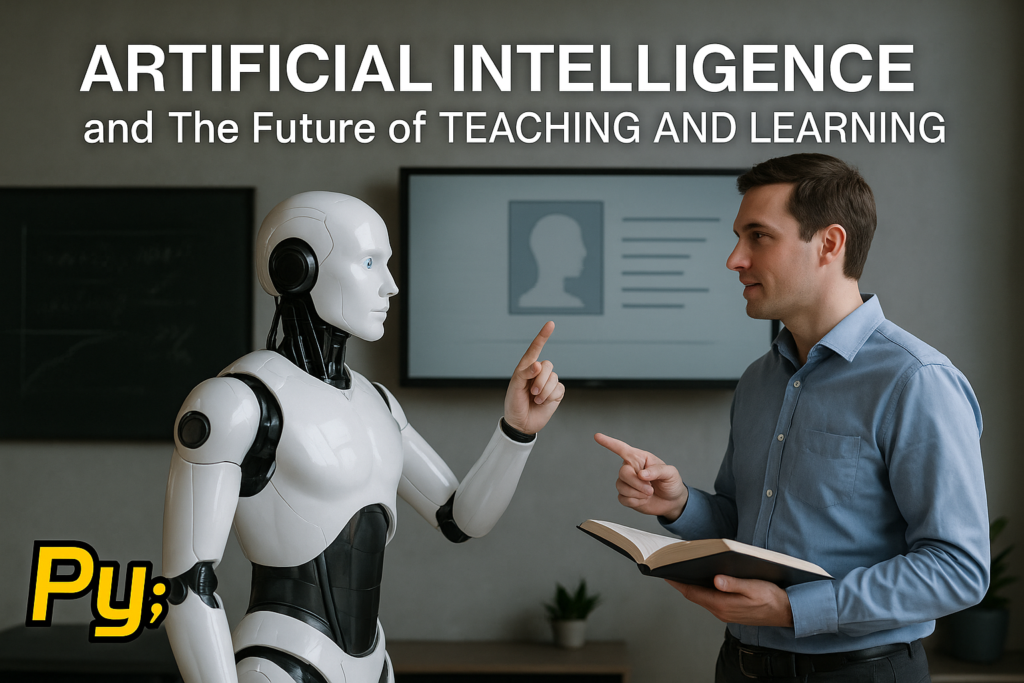
Here’s a truth we often miss: AI doesn’t care. It has zero stake in any decision or result.
This might sound obvious, but it’s actually huge when comparing AI and human intelligence. I’ve been deep into AI projects where the model’s “decision” affected real people’s lives — like loan approvals or medical diagnoses — and the cold reality hit me hard.
Unlike us, AI feels no responsibility, no regret, no pressure. It just spits out what fits the data best.
This lack of “caring” means AI can be ruthlessly efficient, but it also means it misses the nuance humans bring to decisions. Take healthcare AI: it might flag a risky patient for a procedure based on numbers, but it can’t weigh emotional, social, or ethical factors like a doctor can.
According to a 2023 Harvard study, over 60% of AI misjudgments in medical settings stem from ignoring these “human factors” (Harvard Med). And trust me, I’ve seen projects stall because engineers forgot this and treated AI outputs as gospel.
When you think about business, this gap becomes glaring. AI might push for maximum profit by recommending layoffs or aggressive pricing strategies, but it doesn’t “feel” the fallout — lost jobs, unhappy customers, damaged reputations.
That’s why human oversight remains essential. As AI ethics expert Joanna Bryson says, “We cannot delegate moral responsibility to machines because they lack conscience.” And I couldn’t agree more. 🧠❤️
This “no stake” difference impacts accountability too. If an AI causes harm, who’s responsible? The programmer? The company? This grey zone fuels debates worldwide and slows adoption in sensitive sectors like law and finance.
According to PwC’s 2024 AI report, 75% of executives worry about accountability issues limiting AI’s potential (PwC AI Report).
From my experience, embracing AI’s strengths means accepting its emotional and ethical blindness. It’s not a partner—it’s a tool.
A powerful, data-crunching, tireless tool that makes our jobs easier but can’t replace the human heart behind decisions.
So, next time you marvel at AI’s speed or accuracy, remember: it’s a chess player without passion, playing moves without consequence.
And that’s why human intelligence will always be the anchor in a world with AI.
Can AI Ever Replicate Human-Like Intelligence?
No, AI cannot replicate human-like intelligence—at least not in the way people often assume. And here’s why: what we call “intelligence” in machines is pattern-matching, not understanding.
I remember asking ChatGPT to explain grief to me after losing someone—it gave me perfect definitions, psychological models, even cultural references. But it didn’t get it. It didn’t feel the loss. That’s the gap.
As AI researcher Joanna Bryson once said, “AI is just a mirror. It reflects back what we put in, nothing more.“
The biggest block is consciousness, often called the “hard problem” in neuroscience.
David Chalmers, the philosopher who coined the term, explained that while we can describe how the brain processes inputs, we can’t explain why it feels like something. Machines don’t have inner experiences. They simulate reasoning, not own it.
That’s why current AI, no matter how advanced, is still an automaton behind a fancy interface.
You’ve probably heard of Anthropic’s Claude or OpenAI’s GPT-4 passing high-level exams, but that’s just performance. Not comprehension.
In fact, MIT’s 2024 study showed that large language models often hallucinate logical connections in open-ended questions—passing some benchmarks but failing miserably in tasks that require causal reasoning (source).
This makes them unreliable in any domain where context and intent shift moment by moment, like ethics, caregiving, or negotiation.
And let’s not forget, AI lacks “wants”. It doesn’t have goals unless we program them.
That means it can’t form opinions, can’t change direction, can’t rebel—or evolve—like humans do.
Now here’s where most AGI debates go off track: they chase cognitive mimicry, not meaningful alignment.
Take Meta’s LLaMA 3, which boasts impressive long-form generation. But guess what? Even its creators admitted that output quality is heavily dependent on prompt tuning.
It’s still an extension of our intelligence, not a being of its own. 😶
And let’s talk ambition. Humans are unpredictable. We act against logic, we suffer, we love, we care.
In contrast, AI executes. It never asks “should I?”—only “can I?”
This difference isn’t just technical—it’s existential.
I once built a personal bot that simulated my writing voice. It was eerie.
It used my phrases, my humor, even my sarcasm. But it had zero intention. It could sound like me, but it wasn’t me.
To top it off, even Google DeepMind’s 2025 internal whitepaper acknowledged that while AI can outperform humans in constrained rule-based environments, it fails consistently when given ambiguous or open-ended tasks where humans thrive (source).
That’s not something you fix with bigger models. That’s a paradigm flaw.
So no—AI won’t become human. It’ll get better at pretending to be human.
But behind every reply, every prediction, every poem—it’s still just math. Powerful? Yes. Human-like? Not even close.
Author: Rayan Noor, founder of Pythonorp.com, CS student, ML enthusiast, and occasional midnight chatbot philosopher 🧠💭
Final Thoughts: Should We Even Be Comparing the Two?
No, AI and human intelligence are not the same, and comparing them 1:1 leads to confusion more than clarity.
I’ve worked on both sides—training LLMs and managing people—and the biggest gap I see isn’t speed or logic, it’s stake in the outcome.
Humans care, machines don’t.
I remember debugging a model that diagnosed chest X-rays faster than junior doctors—great, right?
But when it missed a rare lung condition due to lack of data context, it didn’t lose sleep, I did.
And that’s the core problem.
AI doesn’t feel regret. It doesn’t learn from mistakes the way we do—through pain, embarrassment, empathy, or ethics.
MIT researcher Sherry Turkle puts it well: “We’re designing machines that pretend to care. And we’re starting to care for them.”
That’s dangerous. 🤖💔
A 2024 study by Stanford AI Index Report showed AI can outperform humans in benchmarked logical tasks by 92.3%, yet it still fails miserably in open-ended reasoning or moral dilemmas.
These aren’t minor bugs—they’re the whole point of being human.
We also fall into the trap of thinking “AI = better human.”
Wrong lens.
We don’t ask whether a calculator is more creative than a mathematician.
AI excels at tasks, not understanding.
It thrives on rules, patterns, and boundaries.
Meanwhile, I’ve seen interns with zero experience outperform tools like GPT-4 in idea generation simply because they broke the expected logic.
That kind of raw, irrational spark? Still 100% human.
Instead of competing, we should be asking: how do we combine strengths?
AI doesn’t get tired, bored, or emotional—so let it handle the repetitive grind.
Humans improvise, dream, and care—let us handle the rest.
“Human-AI collaboration” is the actual future, not replacement.
A McKinsey Global Institute study from 2023 found that jobs augmented by AI saw a 22% productivity boost compared to those trying to fully automate tasks. (Source)
So yeah, stop asking “Who’s smarter?”
It’s not chess.
It’s more like… teamwork.
Let AI calculate.
Let humans decide.
Let both thrive. 💡