

You’re about to choose between two careers that look similar on the surface but lead to completely different lives.
One helps companies make money from data.
The other helps companies avoid losing millions from attacks.
Both pay well.
Both grow fast.
Both look “safe” from the outside.
But they demand very different skills, mindsets, and stress tolerance.
Here’s a fact that should wake you up.
The average global data breach cost reached 4.45 million dollars according to IBM’s Cost of a Data Breach Report.
At the same time, the US Bureau of Labor Statistics projects strong growth for data related roles as businesses rely more on analytics for decisions.
Money flows through data.
Risk flows through security.
I remember when I first started exploring tech careers. I thought data analytics and cyber security were just two branches of the same tree. Both sounded technical. Both sounded impressive. I quickly realized they attract completely different personalities.
Friends who loved charts, SQL queries, and business meetings gravitated toward analytics.
Friends who enjoyed Linux terminals, packet sniffing, and breaking systems leaned toward security.
So this guide will do something simple.
No hype.
No vague motivation.
No generic advice.
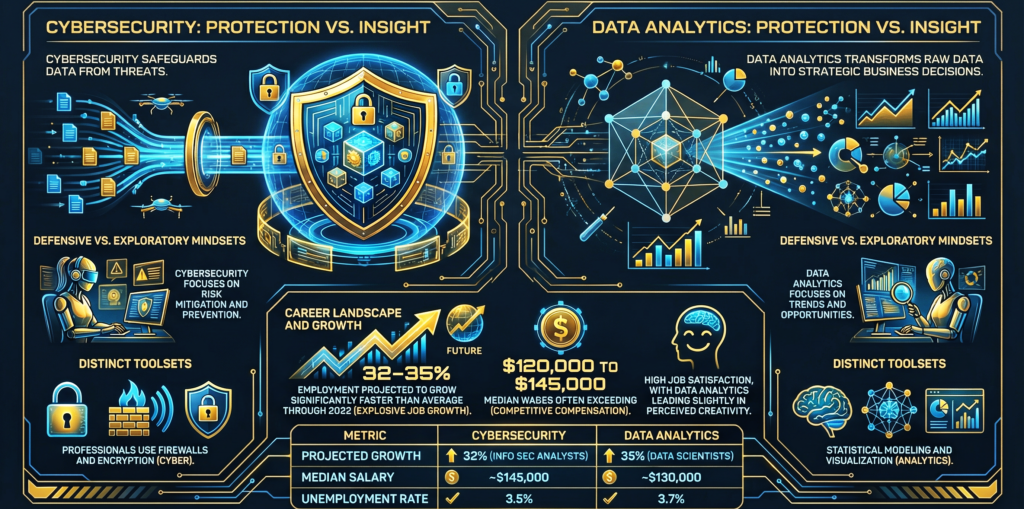
You’ll learn:
- What each role actually does daily
- Which one pays more at each stage
- Which one is harder to break into
- Which one fits your personality
- Which one handles stress better
- Which one makes more sense in 2026
By the end, you won’t just “understand the difference.”
You’ll know which path fits you.
Let’s get straight into Data Analyst vs Cyber Security and settle this properly.
Did you know
That cybercrime is projected to cost the world $10.5 trillion per year by 2025 as digital threats rise globally? That’s why cyber pros are in high demand globally.
- What’s the Real Difference Between a Data Analyst and a Cyber Security Professional
- Which One Has Better Job Demand and Future Growth
- Which One Pays More (Entry to Senior)
- Which Career Is Harder to Break Into
- What Kind of Personality Fits Each Career
- Remote Work, Work Life Balance and Stress
- AI Is Changing Everything So Which Career Is More AI Proof
- If You Want to Work With Businesses Not Just Code Which Path Wins
- Career Switching Can You Move Between Them
- Which Career Has a Lower Barrier to Entry in 2026
- Final Decision Framework How Should You Actually Choose
- FAQ
What’s the Real Difference Between a Data Analyst and a Cyber Security Professional
Short answer right away
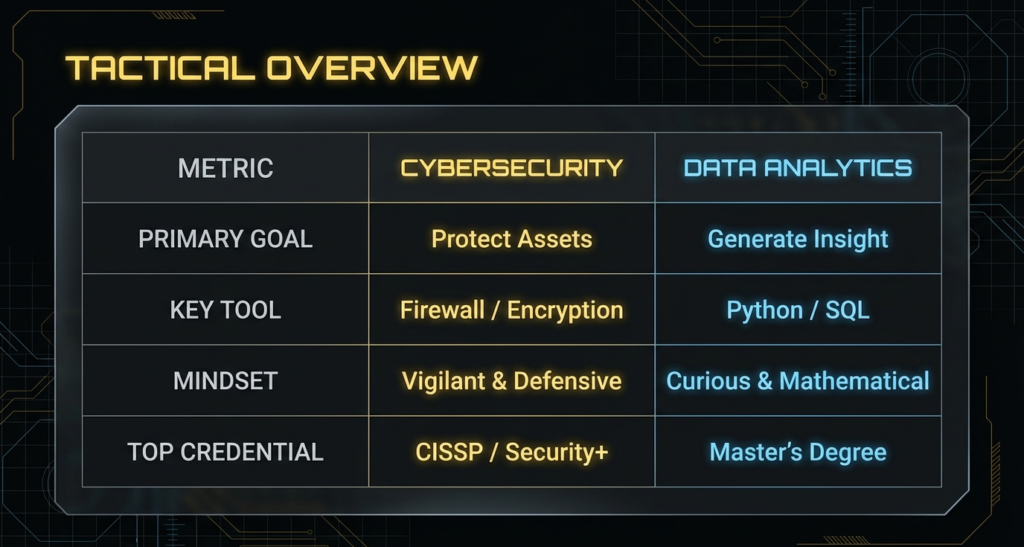
Data Analysts turn raw numbers into business decisions.
Cyber Security professionals protect systems and data from hackers and threats.
That’s the core split you need to understand before anything else 😎
Let’s dig deep…
What a Data Analyst actually does every day
Data Analysts spend most of their time doing things like:
- Collecting and cleaning data from different sources
- Finding hidden patterns in messy datasets
- Making dashboards people actually use
- Answering business questions with numbers
- Reporting insights that help teams make smart decisions
This isn’t guessing games right? It’s real interpretation of data with tools like SQL, Python, Tableau, Power BI and more 👇
Here’s something I personally noticed working with analytics teams and students: most beginners overestimate how much data analysts just “look at graphs.” The real work is cleaning broken data and telling a story management can ACTUALLY use 🙂 That skill separates good analysts from average ones.
What a Cyber Security Professional actually does every day
Now imagine you wake up and your job is to keep attackers out. That’s cyber security in a nutshell.
Cyber roles include things like:
- Monitoring systems for threats
- Blocking hacks and malware
- Running risk assessments
- Testing systems for weaknesses
- Responding to security incidents when they happen
This is not a chill, predictable job. You’re often racing against time when a threat pops up! Tools here include firewalls, SIEM platforms, network monitors and scripting languages 👇
On Reddit, people in security often joke that their average day feels like a “code detective movie” — logs everywhere, tools pinging, and the thrill of catching anomalies 😅
One sentence comparison you can use everywhere
- Data Analysts help businesses understand data
- Cyber professionals help businesses protect systems
Both matter in tech, but they solve very different problems 🧠
Which One Has Better Job Demand and Future Growth
Let’s answer this with straight facts.
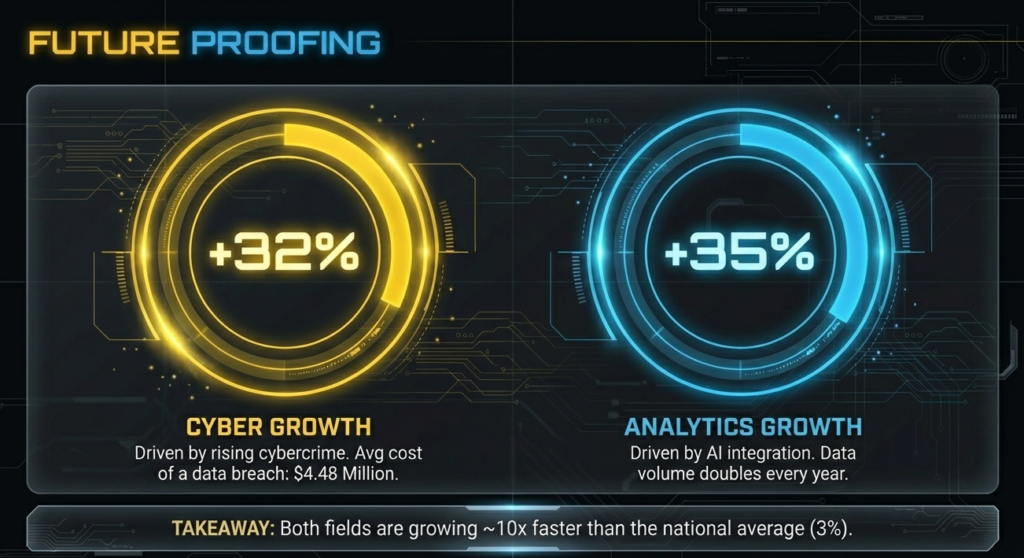
Is Data Analytics still in demand?
Yes 👍
The world is collecting insane amounts of data. Every business wants to understand customer behavior, product performance, sales trends, churn predictions and more.
Check this: Data and analytics roles are among the fastest-growing jobs in tech — business leaders can’t make decisions without them 📈
Typical growth: analysts can expect strong demand for years, especially as more companies adopt BI tools and predictive models.
Is Cyber Security more future-proof?
Also yes 👍
Cyber attacks keep rising globally. Every company with online systems must secure them.
Cyber security roles are forecast to grow faster than many IT jobs because defense is a must-have, not a “nice to have.”
In fact, global cybercrime costs are projected in the trillions of dollars soon — every organization is scrambling for talent.
Side by Side
- Data Analytics growth: Extremely strong
- Cyber Security growth: Very high, slightly faster due to rising threats
| Metric | Data Analyst | Cyber Security Analyst |
|---|---|---|
| Average Salary | ~$74,342 | ~$88,422 |
| Job Growth Rate | ~11% | ~32% |
| Common Skills | SQL, Python, Power BI | Incident Response, SIEM, Windows |
| Education | Bachelor’s Degree (most) | Bachelor’s Degree (most) |
| (Source: Zippia) (zippia.com) |
From real discussions on Reddit: people in both camps confirm it’s not slowing down. But cyber security entry roles often require more foundational work before you land a job.
Which One Pays More (Entry to Senior)
Let’s cut to the numbers.
Entry-level pay
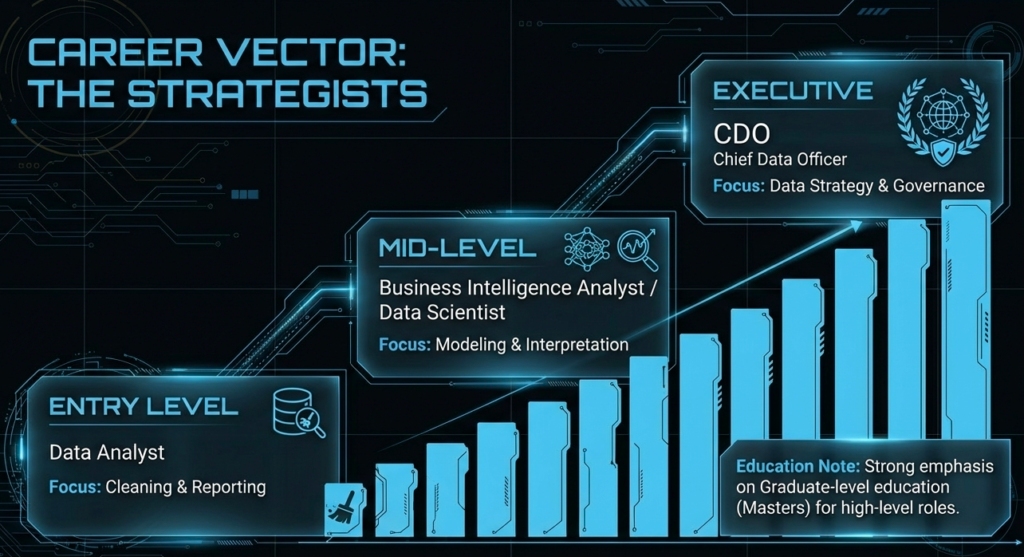
Data Analyst
- Common range ~$60,000 � to ~$80,000 per year in the US
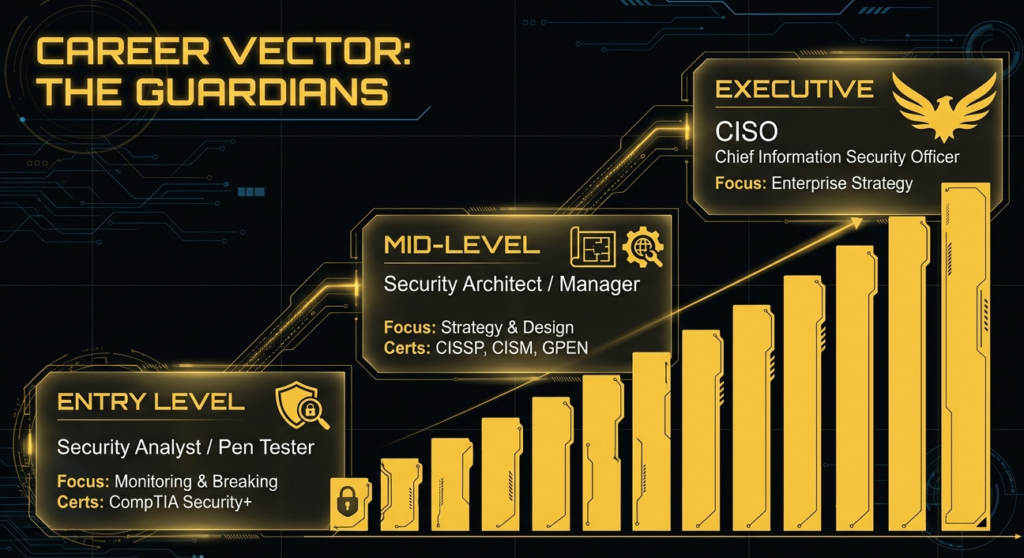
Cyber Security Analyst
- Slightly higher starting range around ~$70,000 � to ~$90,000 per year
So yes, cyber starts a bit higher on average.
Mid-level and senior
As you move up…
Data Analysts who specialize into data science, machine learning or strategic analytics can see earnings rise quickly.
Cyber professionals who become security engineers or architects often command high pay too.
Across multiple sources:
- Cyber roles mid-senior often pay competing or higher salaries compared to analytics
| Career Stage | Data Analyst | Cyber Security |
|---|---|---|
| Entry Level | $60,000 – $80,000 | $70,000 – $90,000 |
| Mid Career | $90,000 – $120,000 | $100,000 – $130,000 |
| Senior / Expert | ~$130,000+ | ~$150,000+ |
| (Source: Cyber Snowden) (Cyber Snowden) |
That matches what job boards show and what tech friends tell me — security pays well if you stick with it and build expertise fast.
Which Career Is Harder to Break Into
Short question short answer:
Cyber security requires deeper foundational tech skills before you can land a good job.
Data analytics tends to be easier to start without tons of prerequisites.
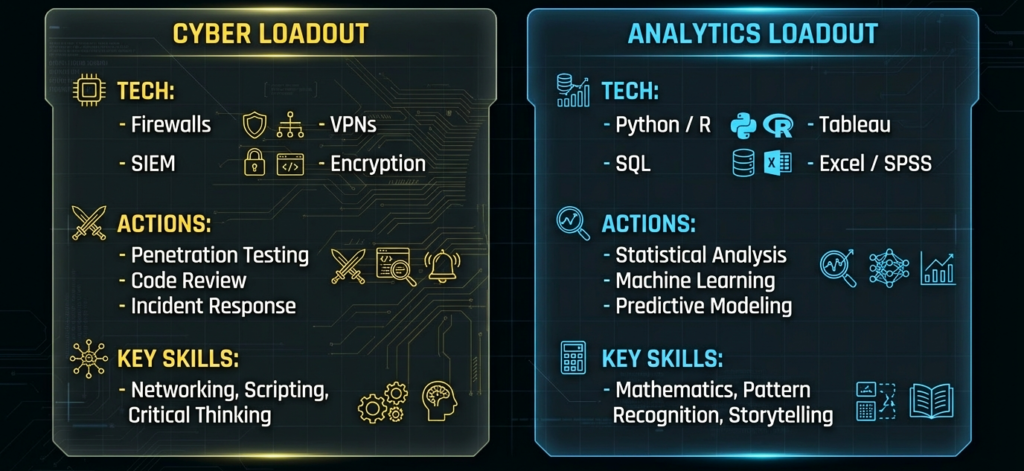
Here’s how it breaks down:
Skills for Data Analysts
- Strong SQL skills
- Basic Python or R
- Data visualization tools
- Math/Stats fundamentals
- Business context understanding
Skills for Cyber Security
- Networking fundamentals (TCP IP etc)
- Operating systems (especially Linux)
- Security tools & monitoring platforms
- Incident response and ethical hacking basics
The Reddit crowd feels this hard too: many said it’s not impossible without experience but landing first cyber job often needs background or hands-on security work.
Personal insight 🤔
When I mentored juniors, I noticed analytics newbies often get a job faster if they have a portfolio of real projects. In cyber security, you also need real world labs, certifications and sometimes a bit of networking experience right from the start.
What Kind of Personality Fits Each Career
Let’s get real honest.
Do you like patterns and business stories or digital defense and challenges?
Data Analytics:
You enjoy logic puzzles, trends, charts and explaining what’s happening behind the numbers.
People in analytics talk about “aha moments” when insights actually change decisions.
Cyber Security:
You love break-it and fix-it puzzles. You’re curious about how systems bend and snap under pressure.
Security folks often describe it as thinking like an attacker, but with discipline.
That difference in mindset matters a lot!
Remote Work, Work Life Balance and Stress
Short answer
Data analyst roles offer more predictable hours.
Cyber security roles carry higher on call pressure.
Now let’s unpack this properly.
Which role offers more remote flexibility
Data analytics fits remote work extremely well.
You need a laptop, access to databases, and communication tools. That’s it.
According to the US Bureau of Labor Statistics, data related roles fall under computer and information research and analytical categories that frequently allow remote arrangements.
From my own observation inside tech communities and Reddit discussions, analysts often report fully remote setups even at entry level. Many companies hire globally for BI and analytics roles.
Cyber security can also be remote.
But some security roles require on site presence, especially in banking, government, and infrastructure sectors.
Security Operations Center roles sometimes involve shift based physical environments.
On Reddit, multiple security professionals mention night shifts and rotating schedules during early career SOC jobs.
Remote exists. But flexibility depends heavily on the company and subdomain.
Which one is more stressful
Direct answer.
Cyber security is generally more stressful.
Here’s why.
If a dashboard breaks, business slows down.
If a breach happens, millions of dollars disappear.
IBM Security reports consistently show average data breach costs in the millions of dollars globally. That financial risk creates pressure.
I have spoken with security engineers who described breach response as “adrenaline mode for hours.”
In contrast, analysts talk about deadlines and stakeholder pressure. Stress exists. It feels different.
Analytics stress is deadline driven.
Security stress is incident driven.
Choose based on how you handle pressure 🙂
AI Is Changing Everything So Which Career Is More AI Proof
Let’s be precise here.
Both fields use AI heavily.
Neither field disappears because of AI.
Will AI replace Data Analysts
AI tools now generate dashboards automatically.
Tools like AutoML and BI copilots can summarize trends.
But businesses still need humans to:
- Define the right business question
- Validate data quality
- Interpret context
- Communicate decisions
McKinsey research on data driven organizations shows companies still struggle with translating analytics into action. That translation requires humans.
From Stack Overflow discussions, many analysts mention AI speeds up workflow but does not remove the need for domain knowledge.
I personally tested AI generated dashboards on messy datasets. The output looked clean. The insights were shallow.
Human judgment wins.
Will AI replace Cyber Security professionals
AI already detects anomalies and suspicious traffic.
Security Information and Event Management systems use machine learning for threat detection.
But attackers also use AI.
That creates an arms race.
Gartner has repeatedly emphasized the global shortage of cybersecurity talent despite automation advances.
Security experts on Reddit frequently say automation reduces noise but increases expectation.
Humans still investigate incidents and design defense strategies.
Unique angle you rarely see
Here’s the interesting part.
AI models themselves require protection.
Data poisoning attacks and adversarial attacks target machine learning systems.
This creates a hybrid niche called AI security.
That area connects data analytics and cyber security.
Few blogs highlight this intersection clearly.
If you position yourself there, you future proof both skillsets.
If You Want to Work With Businesses Not Just Code Which Path Wins
Short answer.
Data analytics gives more exposure to business leaders.
Cyber security interacts more with IT and compliance teams.
Who presents to executives more often
Data analysts frequently present dashboards to marketing heads, product managers, and CEOs.
Communication skills directly impact career growth here.
From my experience mentoring analytics students, those who improved storytelling skills advanced faster than purely technical peers.
Cyber professionals also present reports.
But early career roles focus heavily on technical monitoring and compliance documentation.
Executive interaction increases at senior levels like security architect or CISO.
Which one shows visible impact
Analytics impact often shows as revenue growth, cost savings, or performance improvement.
You can literally measure impact in numbers.
Security impact shows as avoided disaster.
That is harder to quantify emotionally but extremely critical financially.
If you enjoy influencing business strategy openly, analytics aligns better.
If you enjoy protecting assets quietly behind the scenes, security fits perfectly.
Career Switching Can You Move Between Them
Direct answer.
Yes. It is possible.
It requires intentional skill building.
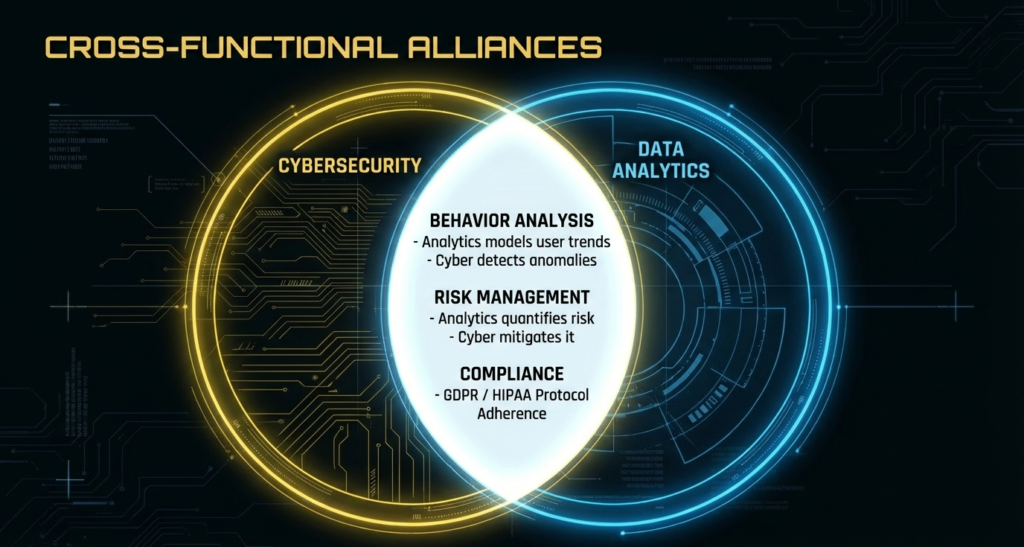
From Data Analyst to Cyber Security
You can move into:
- Security analytics
- Threat intelligence
- Fraud detection
Security analytics heavily relies on log analysis and anomaly detection.
That overlaps with data skills.
You would need to add networking and security fundamentals.
Many professionals on Reddit confirm this path works especially inside large enterprises where internal transfers are common.
From Cyber Security to Data Analytics
Security professionals handle massive logs and incident reports daily.
That is data.
Transition path includes:
- Learning SQL deeply
- Mastering visualization tools
- Strengthening statistics
Cyber professionals already understand risk modeling. That helps in analytics.
Hybrid professionals are rare. That increases their market value.
Which Career Has a Lower Barrier to Entry in 2026
Short answer.
Data analytics has a lower entry barrier.
Cyber security requires stronger technical foundations.
What matters more Certifications or Portfolio
In analytics:
Portfolio dominates.
Hiring managers want to see real dashboards, SQL queries, and business case studies.
On Stack Overflow and hiring threads, recruiters often say portfolio projects beat certificates.
In cyber security:
Certifications carry weight.
CompTIA Security+, CEH and similar credentials often act as screening filters.
Many Reddit users confirm HR departments require certs for initial shortlist.
Which one can you self learn faster
Analytics learning path typically includes:
- SQL
- Excel
- Basic Python
- One visualization tool
With focused effort, beginners can build job ready portfolios within months.
Cyber security learning path includes:
- Networking fundamentals
- Operating systems
- Security tools
- Labs and practice environments
It usually takes longer to become hire ready.
That does not mean impossible. It means structured effort.
Final Decision Framework How Should You Actually Choose
Let’s simplify everything.
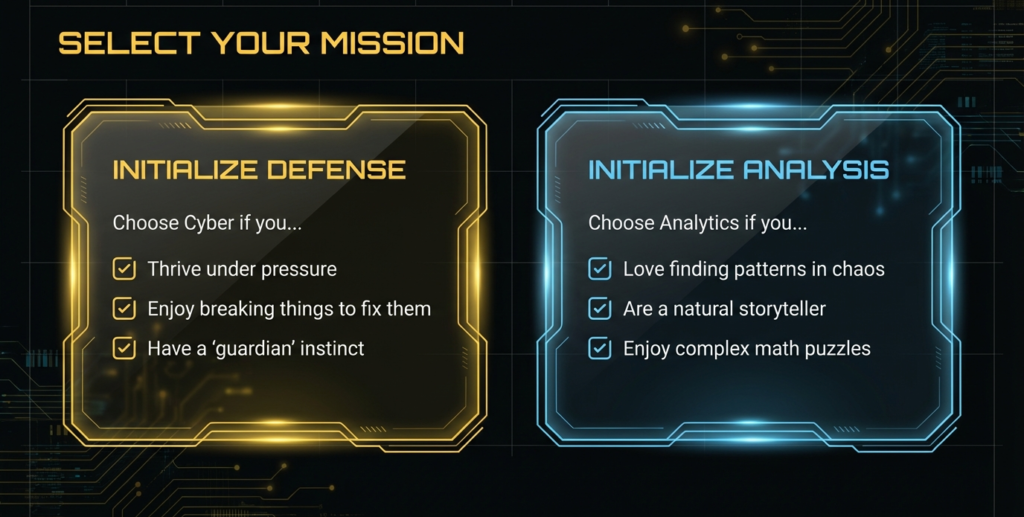
Choose Data Analyst if you:
- Enjoy working with numbers daily
- Like presenting insights to business teams
- Prefer structured deadlines
- Want a slightly smoother entry path
Choose Cyber Security if you:
- Enjoy networking and system internals
- Stay calm under pressure
- Like defensive strategy thinking
- Accept occasional on call stress
Still confused
Ask yourself two questions.
Do I feel excited explaining trends in data
Or do I feel excited hunting digital threats
Your answer reveals more than salary charts ever will 🙂
FAQ
Is data analyst easier than cyber security
Yes.
Analytics requires fewer foundational infrastructure skills.
Cyber security demands networking and systems depth.
Which pays more data analyst or cyber security
Cyber security often starts slightly higher.
Both reach high salaries at senior levels.
Can I switch from data analyst to cyber security later
Yes.
Security analytics and threat intelligence provide natural transition paths.
Which career is more future proof
Both are strong.
Security grows with increasing threats.
Analytics grows with business digitization and AI.
Do I need a degree
Not strictly.
Strong portfolio helps in analytics.
Certifications and labs help in cyber security.
Now you have facts.
No hype. No fluff.
Just a clear comparison of Data Analyst vs Cyber Security so you can decide with confidence!