

AI is hungry. Every second, millions of devices collect data that needs to be processed instantly. But here’s the catch: sending all that data to the cloud causes delays, bandwidth overload, and security headaches. That’s where edge computing swoops in — and when it teams up with machine learning, things get wild.
Here’s a mind-blowing stat to kick things off: according to IDC, over 75% of enterprise data will be processed at the edge by 2025. That’s not just a trend — it’s a massive shift in how intelligence is deployed and decisions are made.
So what will you get from this post? A clear, practical breakdown of:
- How edge computing and ML are merging to reshape industries
- Why this shift matters for business leaders and developers alike
- Real-world examples that show how this convergence is already unlocking smarter, faster systems
I still remember the first time I deployed a small ML model on a local Raspberry Pi. It was just recognizing voice commands — but seeing it respond instantly, without any internet connection, changed how I saw “AI.” That’s when it clicked: the future of machine learning isn’t just in the cloud… it’s closer than we think.
- What exactly is “edge computing” and how does it differ from traditional cloud ML?
- Why are edge computing and ML converging now — what changed?
- How do you design an edge-ML system – what’s the lifecycle? (The less-talked-about “edge-native” pipeline)
- What are the biggest underrated risks – and how do you mitigate them?
- Which industries and use-cases are truly benefiting – and where is the “magic” happening?
- What is the future of edge + ML – what should you plan for?
- How do you get started – practical steps and pitfalls to avoid
- FAQ – quick answers to likely questions
- Final thoughts – the practical takeaway (my advice in one paragraph)
What exactly is “edge computing” and how does it differ from traditional cloud ML?
Quick answer: Edge computing means processing data closer to where it’s generated; machine learning (ML) means algorithms that learn patterns from data. The difference in practice is about where models run and how data is handled.
Wait – what counts as “edge”?
- Edge computing refers to data processing done near the data source — e.g., sensors, IoT devices, gateways, micro-data centres. (Wikipedia)
- Key characteristics:
- Lower latency: decisions happen faster because you skip or reduce round-trip to cloud.
- Reduced bandwidth use: less raw data sent to the cloud.
- Privacy/sovereignty gains: data can be processed locally.
- It’s not just “on the device” (though that is a subset), and it’s not purely “in the cloud”. It sits somewhere between.
What about “machine learning”? (And is it always the same as AI?)
- ML is the subset of AI that uses data + algorithms to learn patterns, make predictions or decisions.
- In this context, we care about:
- Training: building the model from data.
- Inference: using the model to predict or decide in real time.
- Why workload matters: At the edge you often cannot run huge training jobs; you may focus on light inference or fine-tuning.
So what’s the difference in practice—cloud vs edge ML pipelines?
- Cloud-centric ML:
- Big, centralised data lakes.
- Training heavy models in large compute clusters.
- Inference sometimes in cloud or via API.
- Edge-centric ML:
- Data captured at the edge, pre-processed locally.
- Models may be smaller, optimized for device/gateway.
- Inference happens near real-time; sometimes training/fine-tuning happens locally or in federated fashion.
- Pros & cons:
- Edge pros: improved latency, less cloud dependency, local autonomy.
- Edge cons: resource constraints (compute, memory, power), distributed management complexity.
- Cloud pros: unlimited scale, rich compute.
- Cloud cons: latency, bandwidth cost, connectivity dependence, potential privacy issues.
Why are edge computing and ML converging now — what changed?
Quick answer: Because hardware, connectivity, software tools and business demands have all matured — making edge + ML a practical, high-value combo.
What has evolved in hardware and connectivity?
- Microcontrollers and edge devices now include NPUs/TPUs and are capable of ML tasks that once required cloud. For example, devices like Raspberry Pi, Jetson, specialized boards. (MDPI)
- Networks: 5G/6G, WiFi6/7, etc. make it feasible to have distributed edge nodes with reasonable connectivity, enabling richer local processing.
- Gateway / micro data-centre hardware is cheaper and more modular — enabling enterprises to deploy edge nodes more easily.
What changed in software, tooling and algorithms?
- Edge-oriented ML frameworks: e.g., TinyML, TensorFlow Lite, specialized inference engines for constrained devices. (AIMultiple)
- Model optimisation techniques: quantisation, pruning, knowledge‐distillation make models much smaller / lighter for edge devices.
- Better orchestration / management tools: deploying, updating and monitoring models across many edge sites is now more realistic.
What’s the business/usage trigger?
- Real-time insights: Industries (manufacturing, smart vehicles, IoT) demand decisions with millisecond latency — edge provides that.
- Data sovereignty/privacy: Regulatory or commercial reasons push processing closer to source rather than sending everything to the cloud.
- Cloud cost & connectivity risk: In remote sites (e.g., industrial, agriculture, vehicles) connectivity may be unreliable; sending tons of data is costly or impossible — edge reduces dependency.
- Market size: The global edge computing market was estimated at USD 23.65 billion in 2024 and is expected to reach USD 327.79 billion by 2033 (CAGR ~33%). (Grand View Research)
How do you design an edge-ML system – what’s the lifecycle? (The less-talked-about “edge-native” pipeline)
Edge-ML systems require an end-to-end lifecycle from
data capture → training/update → deployment → inference/monitoring
— all adapted to distributed, constrained environments.
How do you collect and preprocess data at the edge?
- Data may be streaming (sensor data) or batch (logs) at edge nodes.
- Decide what preprocessing happens locally vs what goes to cloud: e.g., feature extraction or data reduction at edge, raw data forwarding only when needed.
- Special challenge: heterogeneous sensors, variable connectivity means you must handle missing data, connectivity drops.
How do you train or update models when the data is distributed?
- Traditional training in cloud may still happen, but edge systems increasingly use:
- Fine-tuning or incremental learning on local data.
- Federated learning / distributed training: edge nodes collaborate without sending all raw data to the cloud. (arXiv)
- Unique issues:
- Non-IID data (edge data often doesn’t match global distribution).
- Device heterogeneity: different devices/sensors/capacities need adaptive models.
How do you deploy, manage and monitor models at the edge?
- Deployment strategy must accommodate many edge nodes: versions, roll-out, rollback.
- Monitoring: track model drift, resource usage (CPU/memory/power), latency and errors.
- Over-the-air (OTA) updates, remote logging, resilience in offline mode are critical.
How do you handle inference and post-processing?
- Inference may happen entirely on device/gateway, or a hybrid: device for quick decisions + cloud/gateway for heavier analysis.
- Offline mode: edge node must continue when connectivity fails.
- Post-processing: local aggregation, triggering cloud sync when needed.
- Privacy preserving: local anonymization, encryption, or only sending summary data.
# Simple edge-based inference demo
import tensorflow as tf
import numpy as np

# Simulated lightweight ML model
model = tf.keras.Sequential([tf.keras.layers.Dense(1, input_shape=(1,))])
model.compile(optimizer='adam', loss='mse')

# Example input at the "edge"
input_data = np.array([[5.0]])
prediction = model.predict(input_data)

print("Edge Inference Result:", prediction)
What are the biggest underrated risks – and how do you mitigate them?
Short answer: Edge changes the risk surface. You must secure hardware, protect model integrity, and plan governance for distributed decision making.
Why is security at the edge a different beast?
- Physical exposure: Edge devices sit in factories, cars, or streets. They can be touched, stolen, or tampered with.
- Limited resources: Many devices lack CPU, memory, or secure hardware. That limits standard security stacks.
- Supply chain risk: Compromised firmware or malicious third-party components can inject backdoors.
Mitigations I use in real projects:
- Secure boot and hardware root of trust on all production nodes.
- Entity attestation for devices and models before accepting updates. There are lightweight attestation schemes for TinyML devices that work well on constrained hardware. (Preprints)
- Minimal attack surface: reduce open ports, disable unused services, lock down update channels.
- OTA updates with cryptographic signatures and staged rollouts (canary → full).
- Segmentation: isolate edge networks from core corporate networks.
Evidence: researchers stress that security for resource-limited IoT/edge devices needs new architectures and proxies to improve resilience. (MDPI)
Why model robustness matters at the edge
- Quantisation and hardware variance can change model behavior. A model that works on a dev board may fail on a cheap MCU.
- Adversarial inputs and sensor spoofing are realistic in the field.
- Concept drift: local environments change fast.
Mitigations:
- Test on representative hardware early and often.
- Use robust training: adversarial training, augmentation that matches real-world noise.
- Monitor model outputs and fallback rules on the device – if confidence drops, execute safe defaults or escalate to gateway/cloud.
- Remote canary testing for new model versions.
Which industries and use-cases are truly benefiting – and where is the “magic” happening?
Short answer: Anywhere latency, privacy, autonomy, or connectivity cost matters. Real wins are in manufacturing, vehicles, smart cities, agriculture, and distributed robotics.
| Industry | Use Case | Benefit | Example Company |
|---|---|---|---|
| Healthcare | Remote patient monitoring | Real-time alerts | Philips |
| Manufacturing | Predictive maintenance | Downtime reduction | Siemens |
| Retail | Smart shelves | Better inventory accuracy | Amazon Go |
| Transportation | Autonomous vehicles | Faster decision-making | Tesla |
Smart manufacturing – zero-latency control and predictive maintenance
- Why: immediate anomaly detection can stop machines before damage.
- How: small CNNs on gateway or microcontrollers detect vibration or sound anomalies and trigger fast local actions.
- Impact: lower downtime and avoided production loss.
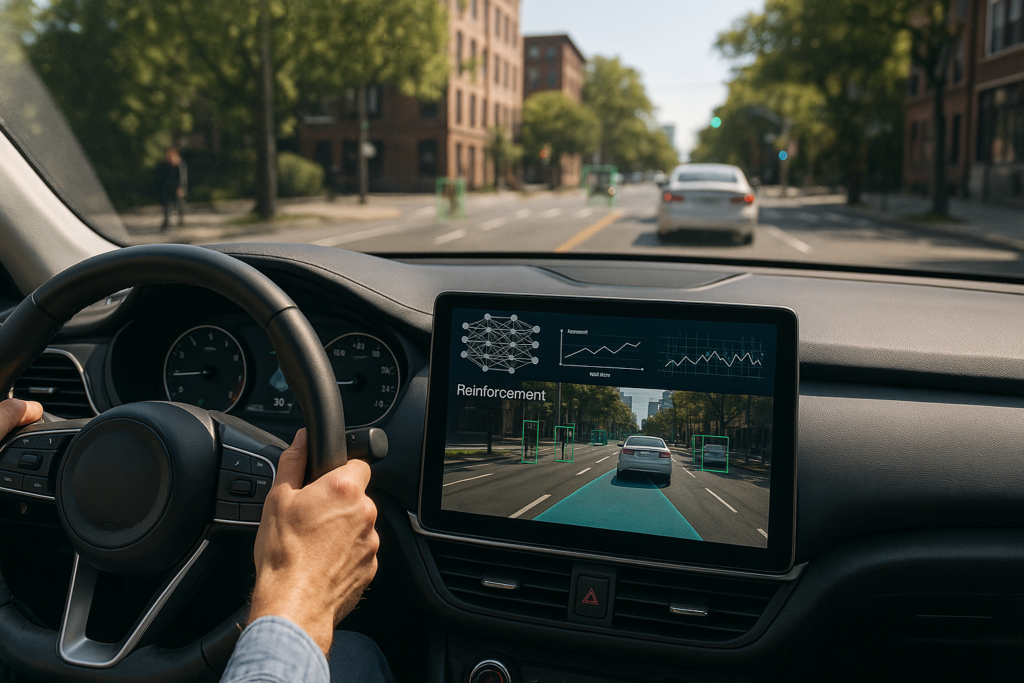
Connected vehicles, drones, and autonomous machines
- Why: millisecond decisions and local sensor fusion.
- How: on-vehicle models handle perception while roadside edge units share context.
- Impact: safer autonomy and lower dependence on uninterrupted connectivity.
Smart cities and public safety
- Why: privacy rules and scale make local processing attractive.
- How: video analytics at street-level nodes that send only metadata to central systems.
- Impact: privacy-preserving surveillance and faster alerts.
Agriculture and remote monitoring
- Why: intermittent connectivity and power constraints.
- How: edge models compress observations and send summaries when connectivity returns.
- Impact: extended coverage and lower data bills.
Unique angle – Edge-to-Edge collaborative ML networks (the undercovered frontier)
Short answer: Edge nodes can learn together peer-to-peer, reducing cloud dependence and improving local adaptation. This is rare in mainstream coverage but powerful!
- What it is: nodes share model updates, gradients, or distilled knowledge with each other across a mesh, rather than funneling everything to cloud.
- Why it matters: it speeds up local adaptation, cuts cloud egress, and preserves privacy.
- How to do it practically:
- Use gossip protocols or federated averaging adapted to peer topologies. (MDPI)
- Employ model distillation so small nodes can absorb knowledge from stronger neighbours.
- Add consistency checks and trust anchors to avoid poisoned updates.
- Risks: trust, convergence, and network churn. Plan for validation and rollback.
- Use cases: drone swarms, sensor meshes, vehicle platoons.
What is the future of edge + ML – what should you plan for?
Short answer: Expect model fabrics, pervasive TinyML, federated/continual learning at scale, and a new operational discipline I call EdgeOps.
Emerging architectures: Edge-First Model Fabric
- Idea: a fabric that spans device → gateway → regional cloud, with automatic workload tiering.
- Behavior: tiny inference on device, heavier on gateway, full retrain in regional cloud.
- Why plan for it: it gives resiliency and efficiency while keeping central oversight.
Algorithms to watch: continual and federated learning at the edge
- Trend: federated continual learning is maturing and targets nonstationary, distributed data. This helps models adapt over time without centralizing raw data. (arXiv)
Operational shift: EdgeOps
- What changes: IT, OT, and ML teams converge. EdgeOps handles deployment, security, data pipeline, and lifecycle for distributed nodes.
- Why: managing hundreds or thousands of edge nodes needs automation, observability, and governance tailored to distributed constraints.
The cloud still matters
- Short answer: cloud is not dead. Use it for heavy training, aggregation, analytics, and long-term storage.
- Hybrid stance: treat cloud and edge as complementary tiers in a model fabric.
How do you get started – practical steps and pitfalls to avoid
Short answer: Start tiny, measure smart, choose the right hardware and toolchain, and iterate.
Step 1: Pick a narrow pilot with measurable value
- Pick a single use-case: e.g., local anomaly detection on one machine or latency-sensitive inference in one vehicle.
- Set clear metrics: inference latency, % of data sent to cloud, local accuracy, MTTR (mean time to recover).
- Scope time and cost: define a 6-8 week pilot. Small wins justify broader rollouts.
Step 2: Choose hardware and frameworks
- Hardware: pick one dev kit that simulates production hardware (Raspberry Pi, NVIDIA Jetson Nano, or a microcontroller with NPU depending on need).
- Frameworks: explore TensorFlow Lite, TinyML toolchains, Edge Impulse, or platform-specific runtimes. TinyML and on-device AI reviews are good starting points. (PMC)
Step 3: Design the edge-native pipeline
- Data plan: what gets processed locally, what goes to cloud, and when.
- Model lifecycle: define update cadence, validation rules, rollback process.
- Monitoring: local logs, telemetry, and aggregated dashboards. Include resource metrics (CPU, memory, energy).
Step 4: Security and governance baseline
- Device identity and secure update channels.
- Auditing for decisions that matter (keep a small, signed log of predictions for later review).
- Privacy: minimize raw data retention and anonymize where possible.
Step 5: Scale carefully
- Automate OTA updates and monitoring.
- Standardize on a small set of certified devices.
- Run chaos tests: unplug nodes, inject noisy sensors, test failover.
Practical cost expectations (quick guide)
- Hardware: $20 – $1000 per node depending on capability.
- Management: expect higher ops cost per node vs cloud-only projects.
- Cloud savings: reduced egress and storage can offset hardware/ops cost for high-data use cases.
- Tip: do a cost-benefit during pilot. Grand View Research shows edge AI integration is a major growth driver as business cases solidify. (Grand View Research)
Common mistakes to avoid
- Thinking edge is only about inference. Plan model updates and data lifecycle too.
- Skipping real hardware testing. Emulators hide real-world variability.
- Overcomplicating the first pilot. Solve one measurable problem first.
- Ignoring security and governance until after rollout.

FAQ – quick answers to likely questions
Do I always retrain at the edge?
No. Often inference is local while training remains in the cloud. Retrain at edge only when local adaptation or autonomy is required. (MDPI)
Will edge make my model less accurate?
Not necessarily. You may use smaller or quantised models, which can slightly reduce raw accuracy, but you can recover accuracy with distillation, hybrid pipelines, or gateway-assisted postprocessing. TinyML work shows strong performance with smart optimization. (arXiv)
How do I secure thousands of remote devices?
Use device identity, signed OTA updates, minimal services, and segmentation. Also implement attestation and staged rollouts. Research shows these controls are essential for resource-limited edge fleets. (MDPI)
Is federated learning practical now?
Yes for many scenarios, but be mindful of heterogeneity, communication cost, and validation. There is growing literature and pilots showing practical FL for edge devices. (arXiv)
What metrics should I track from day one?
- Inference latency (ms)
- Edge accuracy vs baseline
- Data sent to cloud (MB/day)
- Device resource use (CPU, memory, battery)
- Failure/recovery rates
Final thoughts – the practical takeaway (my advice in one paragraph)
Edge + ML is not a fad. It is a strategic shift that trades centralised scale for local speed, privacy, and autonomy. Start with a tight pilot, test on real hardware, bake security and lifecycle management into day one, and experiment with edge-to-edge collaboration when you need faster local adaptation or lower cloud dependence. The technical pieces – TinyML, federated learning, attestation – are maturing now, so the best time to prototype is today! (PMC)
If you want, I can now:
- Expand any section into a full tutorial with code examples (TensorFlow Lite + Raspberry Pi or TinyML on an MCU).
- Produce an architecture diagram and an “EdgeOps checklist” for pilots.
Which would help you more right now?