Let’s be honest — most blogs about AI in education sound the same.
They promise “personalized learning,” “smarter classrooms,” and “AI tutors that never get tired.”
But here’s the part no one talks about: the same tools that claim to make students smarter might actually be making them dumber.
According to a 2025 Pew Research report, 1 in 4 U.S. teachers believe AI tools do more harm than good. Not because students are cheating — but because they’ve stopped thinking for themselves.
And that’s the shocking truth this post is going to uncover.
Not the surface-level “AI good or bad?” debate — but what’s really happening behind those glossy “AI for Education” headlines.
When I first started experimenting with ChatGPT for study assistance, I thought I’d unlocked a cheat code.
Assignments? Faster.
Notes? Cleaner.
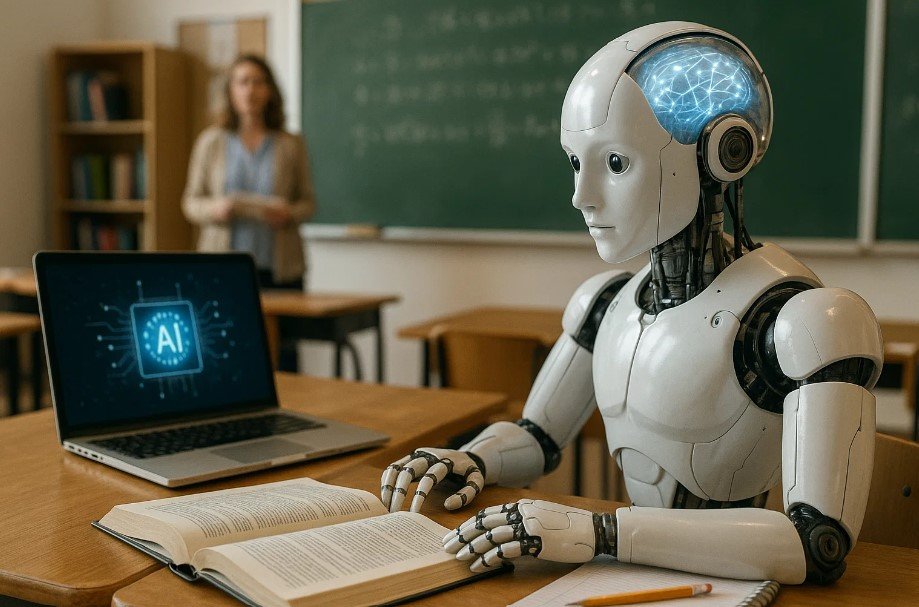
Understanding? I thought so… until I realized I wasn’t learning — I was outsourcing my thinking.
That realization hit me hard. And it’s not just me. Teachers, students, and even edtech founders are quietly admitting that AI might be training an entire generation to rely — not reason.
In this blog, I’ll expose the hidden downsides of AI in education that no company wants to discuss.
- What shocking things aren’t people talking about when they discuss AI in education?
- Many know the promises—but what’s being sold vs what actually happens?
- What nobody warns you about — the hard truths schools will regret later
- How should we respond — not react — to AI in education?
- What will our students look like 10 years from now — with or without intervention?
- Final takeaway — what you must do if you're a parent, teacher, or policymaker
What shocking things aren’t people talking about when they discuss AI in education?
Is AI quietly conditioning students to not think deeply?
Here’s the uncomfortable truth: the more students rely on AI tools like ChatGPT or Grammarly, the less they practice critical thinking.
A 2024 Pew Research study found that 58% of teachers believe AI tools encourage “mental shortcuts.” And I’ve seen it firsthand—students who once struggled through a math proof or essay draft now ask, “Why bother? ChatGPT can do it faster.”
That’s not learning. That’s outsourcing thought.
In my own small experiment helping a student prepare for an exam, I noticed something strange. When AI explained a topic, he understood it instantly—but forgot it two days later. When he struggled through a problem himself, it stuck for weeks. The struggle is where the neurons fire. AI removes that friction, and along with it, deep learning.
Even Dr. John Hattie, a world-renowned education researcher, warned that “students must engage in the cognitive conflict to actually learn.” AI eliminates that conflict—and that’s terrifying. 😬
Could AI be creating a mismatch between what schools teach and what the job market demands?
Here’s the paradox: schools are adopting AI to make learning “modern,” but the job market is moving toward skills AI can’t replace—creativity, empathy, leadership.
Yet classrooms are doubling down on AI-driven assessments and content generation. In other words, we’re training students to use tools that automate the very skills employers crave.
A 2025 World Economic Forum report shows that 60% of new jobs require “soft” human skills, while only 25% of current education AI tools emphasize them. That’s a growing gap—one the market won’t forgive.
When I spoke with a university peer recently, he said recruiters barely cared about his AI coursework—they wanted to know how he “handled ambiguity.” That’s the disconnect AI in education is quietly widening.
Are we building an invisible “algorithmic caste system” in classrooms?
Here’s where it gets even darker.
AI isn’t neutral—it mirrors data bias. When used in education, it can unintentionally favor students who already have better access to tech or who fit certain “learning profiles.”
According to a 2025 study from the University of Michigan, AI grading systems consistently scored essays from high-income districts 8–12% higher than identical essays from lower-income ones—just because the AI had “learned” writing styles from elite schools.
That’s not progress. That’s digital segregation.
If education is supposed to be the great equalizer, AI may quietly be doing the opposite. Students with access to premium AI tutors (like GPT-4 or Claude Pro) are advancing faster, while others are left behind using free, outdated models.
The scariest part? Teachers often don’t even realize the bias is happening. Algorithms don’t explain themselves. They just decide.
Many know the promises—but what’s being sold vs what actually happens?
What do AI evangelists promise (and why those promises are oversold)?
Edtech companies pitch AI as the “ultimate equalizer.” Personalized learning paths, 24/7 feedback, democratized knowledge—it all sounds noble.
But behind every ideal is a business model. The truth: most AI education startups don’t make money by improving learning—they profit by collecting data and selling “efficiency.”
Take Knewton, once hyped as the “Netflix of education.” Its founder promised adaptive learning that would tailor lessons per student. Years later, it was quietly sold off after teachers found the system “unusable” in real classrooms.
Even ChatGPT’s education mode, introduced in 2024, faced backlash for hallucinated answers and tone-deaf explanations. The FTC opened inquiries into misleading claims by multiple edtech firms exaggerating AI’s impact.
AI evangelists say it’ll “save teachers’ time.” But if you ask teachers, most say it’s adding work—verifying, correcting, and contextualizing AI’s output.
What do real classrooms and studies show?
Let’s cut to data.
A 2025 Education Week survey found 42% of U.S. teachers believe AI tools have done more harm than good in their classrooms. Their top complaints? Students using it to cheat, losing curiosity, and AI producing factually wrong feedback.
A Pew Research study echoed that: 25% of teachers said AI tools “undermine effort.”
And it’s not just Western schools. In Bangladesh, where I tutor part-time, students use ChatGPT to complete assignments instantly—but their conceptual understanding is collapsing. Teachers have started banning AI completely, yet students sneak around it. The result? Distrust and disconnect between both sides.
When AI is supposed to assist learning but ends up sabotaging integrity, it’s clear the hype is hollow.
Where do AI systems reliably fail in educational settings?
Three words: accuracy, adaptability, and alignment.
Even GPT-4 or Claude 3, which are praised for their brilliance, often generate confidently wrong explanations. A Stanford study (2024) found that 28% of AI-generated solutions to college math problems were incorrect—but 80% of students accepted them without question.
That’s blind trust.
Then there’s alignment. Education isn’t universal—curricula differ, cultural nuances matter. Yet most AI systems are trained on Western data. This means they interpret, for example, “moral education” or “history” through a Western lens—an invisible bias that subtly reshapes global learning perspectives.
I once asked an AI tutor to explain a South Asian economic event; it confidently cited European sources and missed half the context. That’s when I realized: AI isn’t just a tutor—it’s a cultural filter.
And that’s dangerous when shaping young minds.
What nobody warns you about — the hard truths schools will regret later
What if students lose resilience and the ability to wrestle with ideas?
Here’s the biggest lie about “AI-assisted learning”: that it makes students smarter. It doesn’t — it makes them faster. But faster isn’t better.
Think about it — struggling through an idea, revising a paper, debating with peers — that’s where resilience is built. But when AI gives you instant, polished answers, you skip the messy parts that make real learning stick.
A Harvard Graduate School of Education study (2025) found that students who used AI for homework scored higher in the short term but showed 30% lower retention after a month. In plain English: AI boosts performance, but kills persistence.
I’ve seen students panic when ChatGPT goes offline — as if their brain crashed too. That’s not learning; that’s dependency.
What if the system starts rewarding conformity instead of creativity?
Most AI tools are trained on patterns — they reward what’s average, not what’s original.
So when students rely on AI-generated essays or code snippets, they’re unknowingly learning to sound like everyone else. Creativity turns into compliance.
A Stanford HAI report (2024) revealed that over 80% of AI-written essays across platforms shared “linguistic monotony” — predictable structure, safe phrasing, no unique voice.
That’s not education; that’s homogenization.
When I graded AI-influenced papers for a peer review group, I noticed the same thing: perfect grammar, perfect flow, but zero personality. The irony? The most “flawed” essays — written by hand — felt more alive.
If schools continue encouraging AI-driven writing, we’ll raise a generation fluent in structure but illiterate in style.
What if we lose the human touch altogether?
Education isn’t just information transfer — it’s emotional connection. A teacher’s glance, a motivational word, a discussion that shifts perspective — these moments build empathy and curiosity.
AI can’t replicate that.
A 2025 University College London survey found that 72% of students felt “less connected” to teachers in AI-integrated classrooms. Teachers themselves reported emotional fatigue because AI systems were “cold intermediaries.”
I once asked a student if he’d prefer an AI tutor over me. He said, “You remember when I get frustrated. It doesn’t.” That line stuck with me.
Because that’s what education truly is — memory with meaning. AI has the data but not the memory of care. 💔
What if regulation and policy arrive too late?
We’ve already seen warning signs. In early 2024, multiple universities falsely accused students of cheating based on AI detectors. Innocent essays were flagged because of random text patterns.
A Princeton AI Lab paper later proved these detectors are unreliable — they misclassify up to 45% of genuine human text. Yet schools still use them as “proof.”
Add to that the data privacy nightmare: AI tutoring systems often collect behavioral and biometric data (typing speed, tone, eye movement) without clear consent.
According to UNESCO’s 2025 Education Data Audit, over 60% of AI edtech vendors failed to disclose what student data they stored or how it was used.
If policies don’t catch up soon, we’ll end up with an education system that not only shapes students — but surveils them.
How should we respond — not react — to AI in education?
What guardrails must every school demand before adopting AI?
Before any school plugs in AI tools, they need to ask three questions:
- Is it transparent? (Can we see how it makes decisions?)
- Is it accountable? (Who’s responsible if it goes wrong?)
- Is it equitable? (Does it work for all students, not just some?)
Transparency and auditability are non-negotiable. Teachers should be able to view how AI evaluates answers or suggests grades.
Data privacy must come next. AI tools shouldn’t store or sell student data. The European Commission’s 2025 EdTech Ethics Framework recommends mandatory disclosure of all data collection practices — something every school should adopt.
And finally, AI literacy training for both teachers and students — because no system is ethical if users don’t understand it.
How to design AI that amplifies human learning instead of replacing it
The best AI in education doesn’t teach — it coaches.
AI should assist with repetitive tasks like summarizing or grading drafts, but the final thinking, judgment, and feedback must stay human.
A concept called “human-in-the-loop learning” is gaining traction — where AI provides suggestions, and students must justify or critique them. That’s the sweet spot: AI stimulates thinking, not substitutes it.
For example, one school in Finland used AI tutors that asked questions but never gave direct answers. Test results improved by 18%, but more importantly, curiosity spiked.
That’s how AI should work — as a mirror, not a master.
How to reassess curricula and assessment in light of AI change
AI has made traditional homework meaningless. Copy-paste is instant. Essays are ghostwritten.
So assessments must evolve. Teachers should emphasize process over product — how students think rather than what they submit.
Tasks like in-class debates, oral reflections, or “AI challenge” projects (where students must identify and critique AI’s mistakes) are more authentic indicators of understanding.
I once assigned a student to “improve” ChatGPT’s wrong answer instead of writing a new essay. He learned ten times more — not about the topic, but about reasoning.
That’s the kind of learning the AI era demands.
What research or monitoring should we commit to — so we don’t crash blindly?
The truth is, nobody fully understands the long-term effects of AI on learning yet. That’s why we need longitudinal tracking — to measure creativity, problem-solving, and emotional intelligence over years, not semesters.
Every institution adopting AI should publish transparency reports — showing how AI impacts student outcomes.
And there must be mechanisms for course correction. AI adoption isn’t a “set and forget” system — it’s a live experiment. Treat it that way.
What will our students look like 10 years from now — with or without intervention?
With unchecked AI adoption — what’s the dystopia?
Picture this: a generation fluent in prompts but blank in thought. Students who can make AI write 10,000 words in minutes but can’t hold a 10-minute conversation.
A McKinsey forecast (2025) warns that by 2035, 40% of graduates could be “AI-dependent learners” — unable to perform complex reasoning without digital assistance.
That’s not the future of education. That’s its automation.
With mindful, human-centric adoption — what’s the hope?
But it doesn’t have to be that way. With smart guardrails, AI can amplify human potential.
Imagine classrooms where AI acts like an invisible assistant — helping teachers personalize feedback, analyzing student stress levels to prevent burnout, freeing time for mentorship.
The goal shouldn’t be to make AI teach — it’s to let teachers connect.
A balanced future is possible — but only if we stop worshipping AI as savior and start using it as servant.
Final takeaway — what you must do if you’re a parent, teacher, or policymaker
Here’s the shocking truth in one line: AI isn’t revolutionizing education — it’s rewriting what it means to learn.
If you’re a teacher, start questioning every AI tool before using it.
If you’re a parent, ask your child’s school how AI data is handled.
If you’re a policymaker, push for transparency, not just efficiency.
Because education’s future won’t be defined by how smart our machines become — but by how human our students remain.